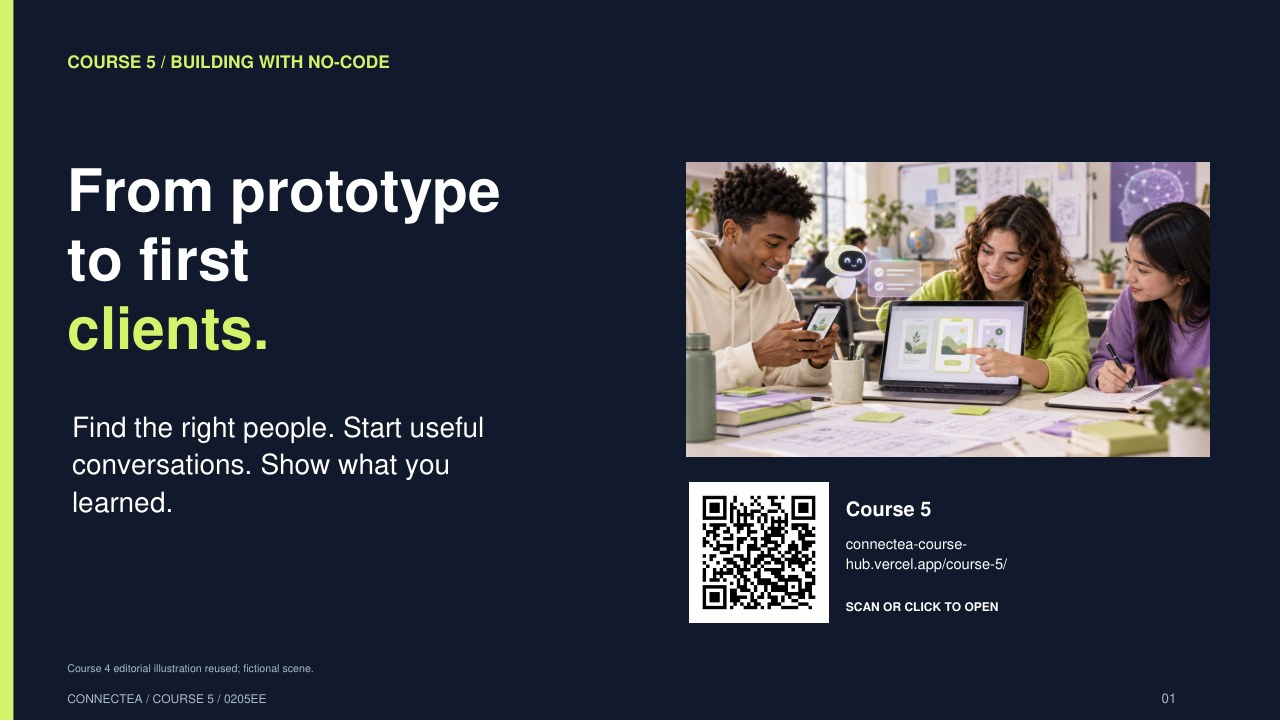
01 / COURSE 5
From prototype to first clients
- Find the right people. Start useful conversations.
- Use a simple CRM to remember the next step.
- Turn what you learn into a stronger portfolio.
Teaching notes
Opening question: your website is live; what would make someone take the next step? This is a three-hour workshop for the existing cohort. A first client is an ambition, not a condition for passing.
02 / TODAY / 180 MINUTES
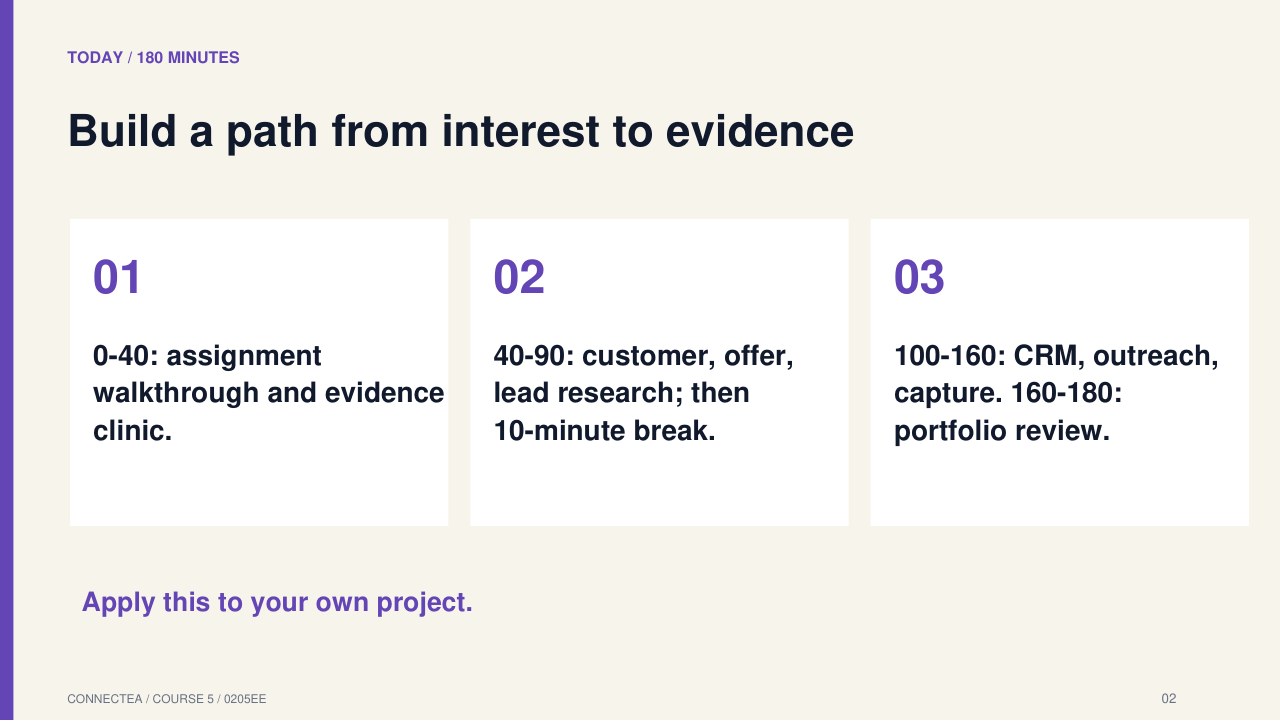
Build a path from interest to evidence
- 0-40: assignment walkthrough and evidence clinic.
- 40-90: customer, offer, lead research; then 10-minute break.
- 100-160: CRM, outreach, capture. 160-180: portfolio review.
Teaching notes
Use the notes as a facilitation guide, not a script to read aloud. Keep most of the session practical. The assignment opening uses 40 minutes; customer research uses 50; break uses 10. In the practical hour, spend 8 minutes on tool choice, 12 on one CRM lab, 20 on conversation practice, and 20 on capture and experiment planning. Use alternatives as optional reading. Keep 20 minutes for portfolio review.
03 / THE ASSIGNMENT
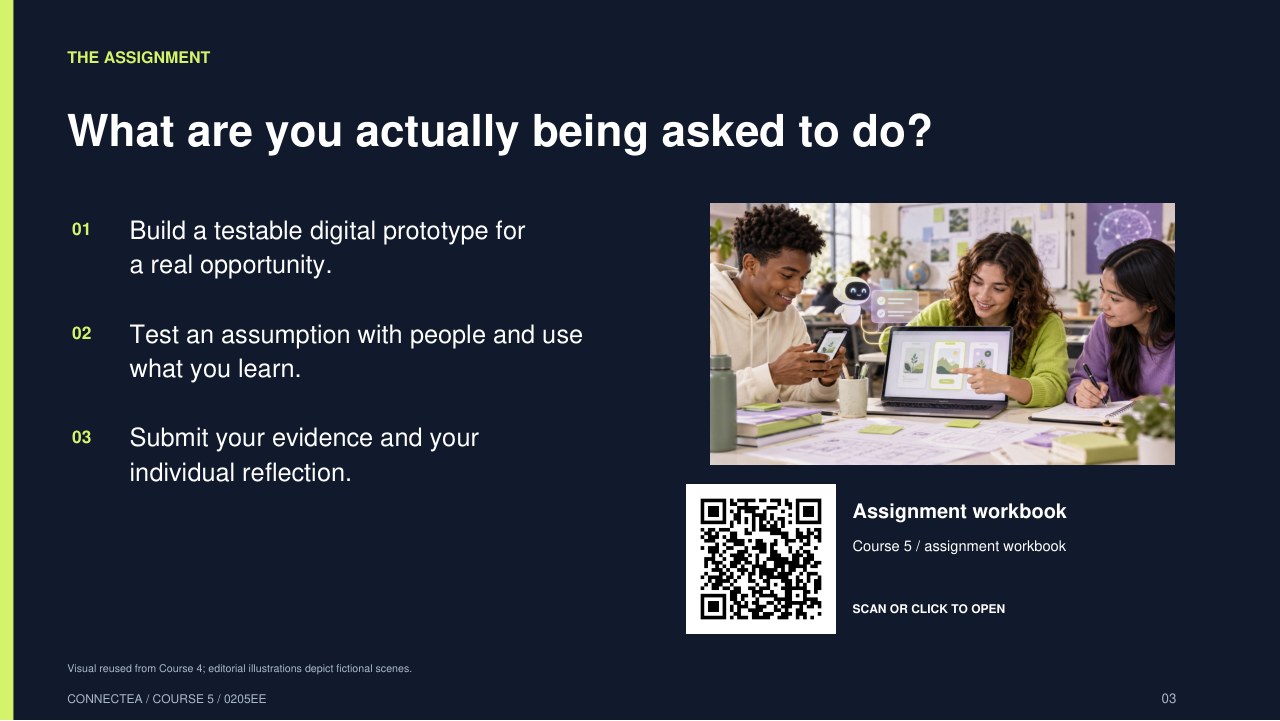
What are you actually being asked to do?
- Build a testable digital prototype for a real opportunity.
- Test an assumption with people and use what you learn.
- Submit your evidence and your individual reflection.
Teaching notes
Ask one student to explain the assignment in their own words. A polished site alone does not explain the entrepreneurial process. These requirements come from the current hub; dates and exam arrangements remain in Google Classroom.
04 / THE ASSIGNMENT
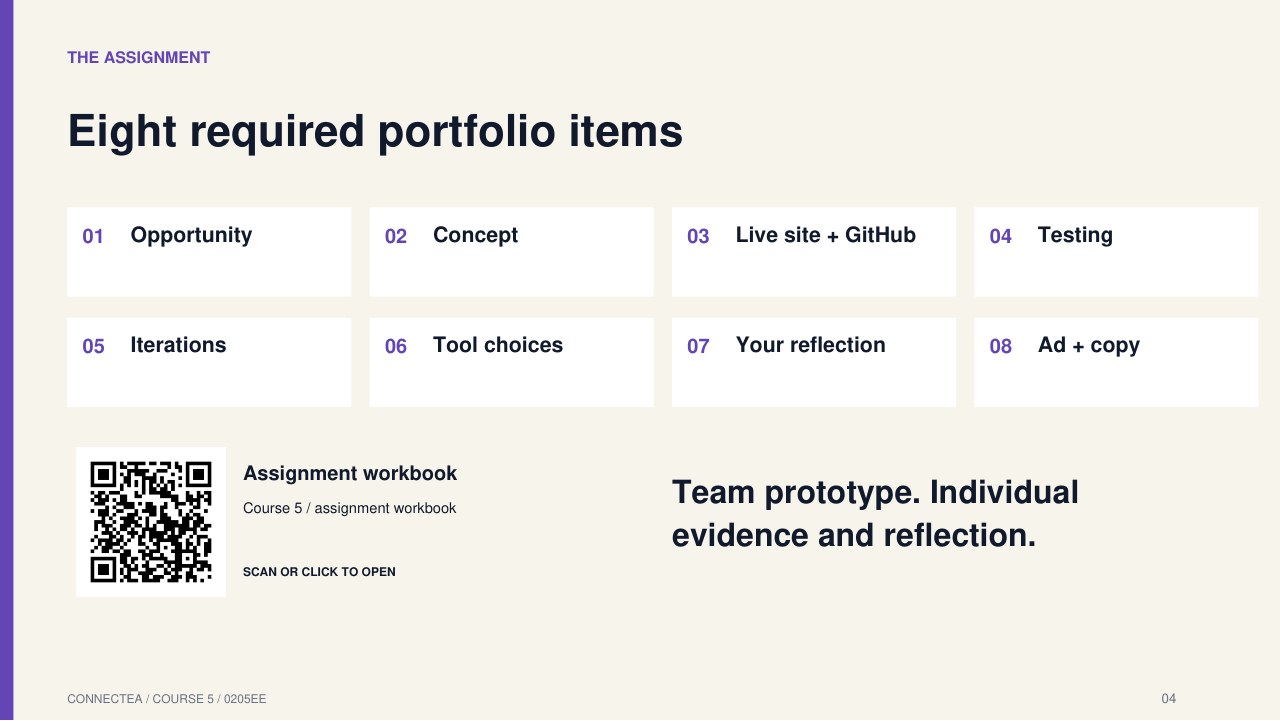
Eight required portfolio items
- Opportunity; concept justification; live site + GitHub.
- Testing evidence; iterations; tool selection rationale.
- Individual reflection; advertisement creative + copy.
Teaching notes
Open the existing Assignment page. Show all eight items and the submission form. The working prototype item includes both live website and repository links. The advertisement includes its creative link and copy. This workshop adds examples, not a ninth required submission.
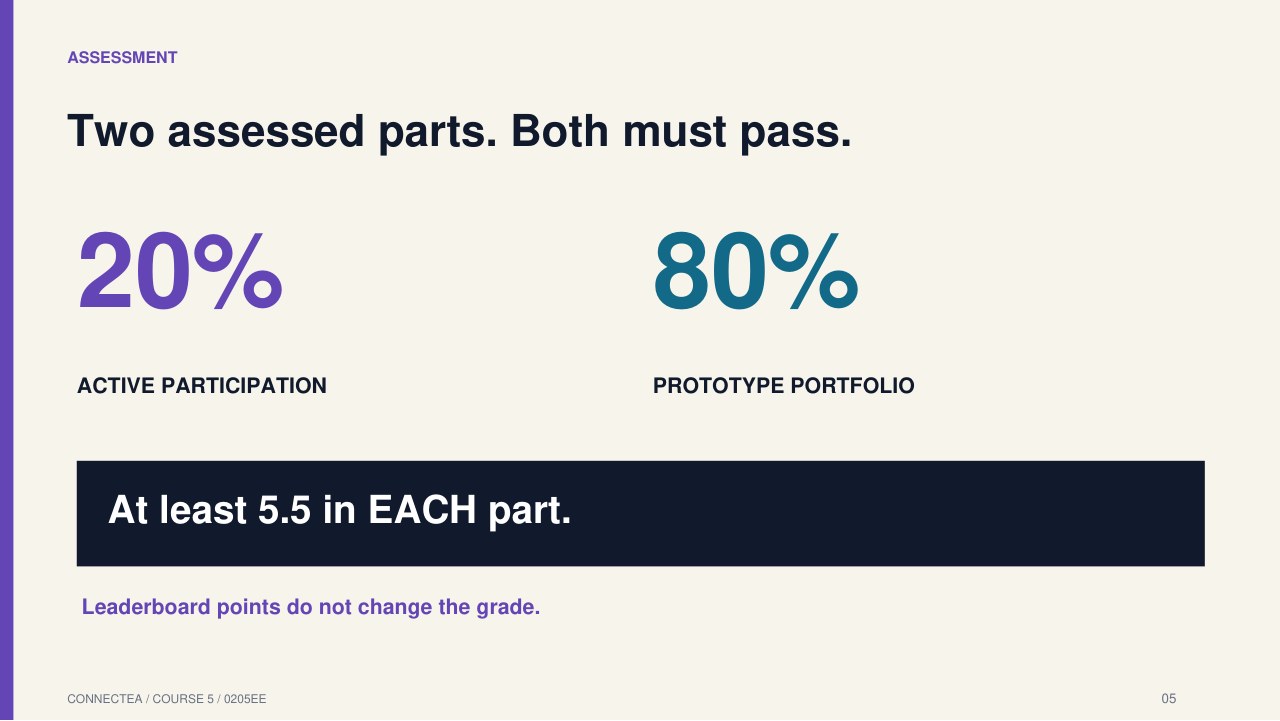
05 / ASSESSMENT
Two assessed parts. Both must pass.
- 20% active participation + 80% prototype portfolio.
- Each component must be at least 5.5.
- Leaderboard points support motivation; they are not grades.
Teaching notes
Worked example: participation 5.0 and portfolio 8.0 gives 7.4 weighted, but the participation component still fails the minimum. Attendance and active contribution are both relevant. Use the existing rubric; do not invent a sales quota or a new grading category.
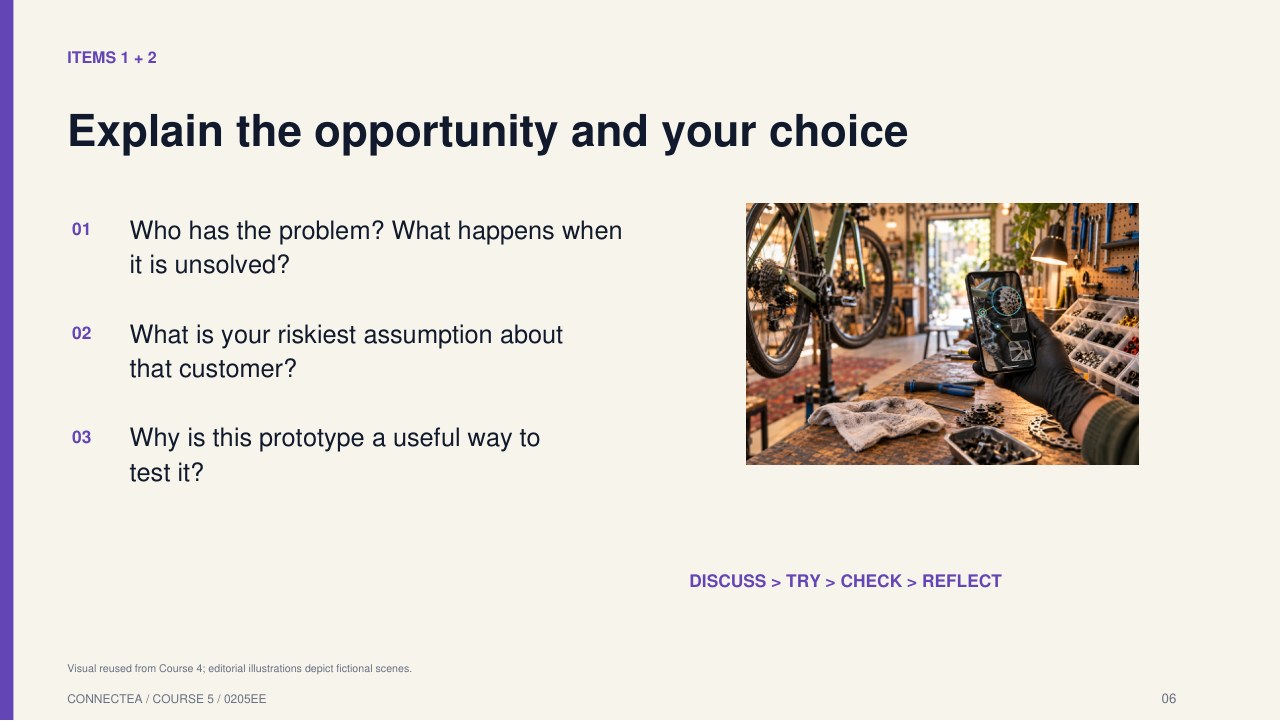
06 / ITEMS 1 + 2
Explain the opportunity and your choice
- Who has the problem? What happens when it is unsolved?
- What is your riskiest assumption about that customer?
- Why is this prototype a useful way to test it?
Teaching notes
Illustrative example: a small retailer may lose enquiries when stock information is unclear. A stock-enquiry flow tests that assumption before building full inventory software. Connect the decision to Lean Startup, Business Model Thinking, or entrepreneurial experimentation.
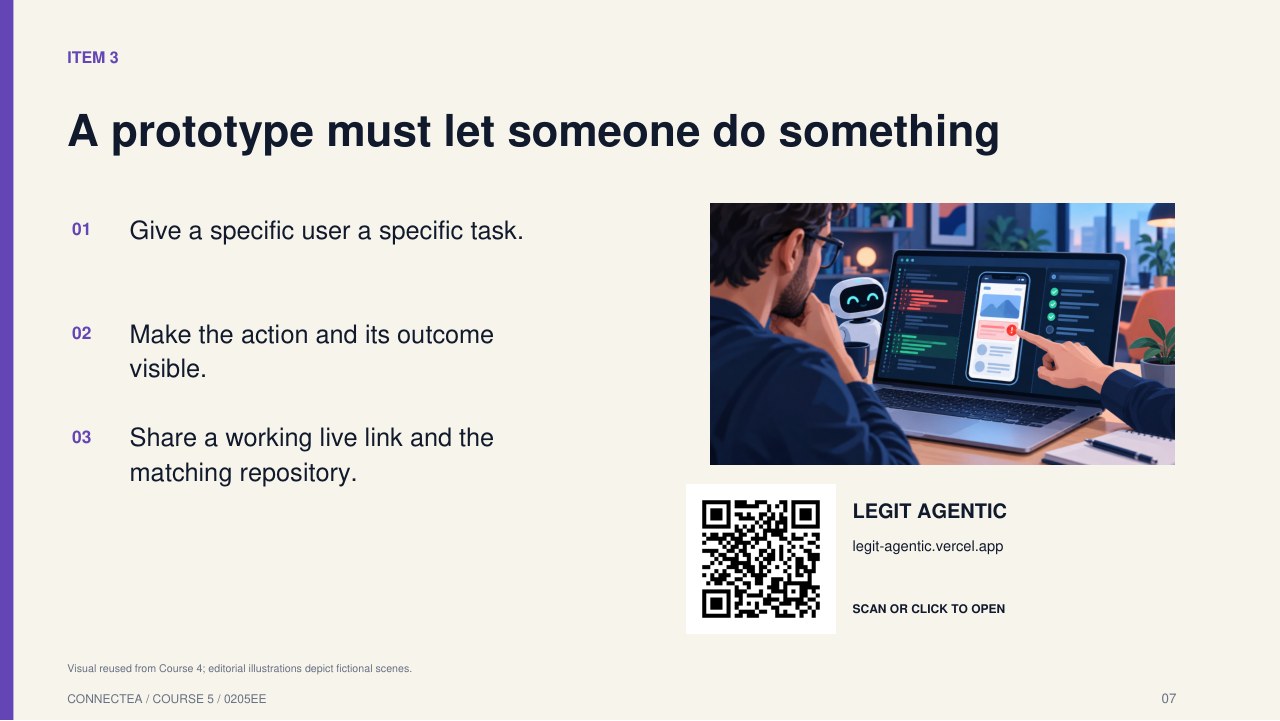
07 / ITEM 3
A prototype must let someone do something
- Give a specific user a specific task.
- Make the action and its outcome visible.
- Share a working live link and the matching repository.
Teaching notes
Example task: find a suitable product and submit a stock enquiry. Check outside the developer account. A screenshot of the homepage cannot demonstrate the complete flow. A repository link does not replace the live prototype. Scope can be small if the flow is testable.
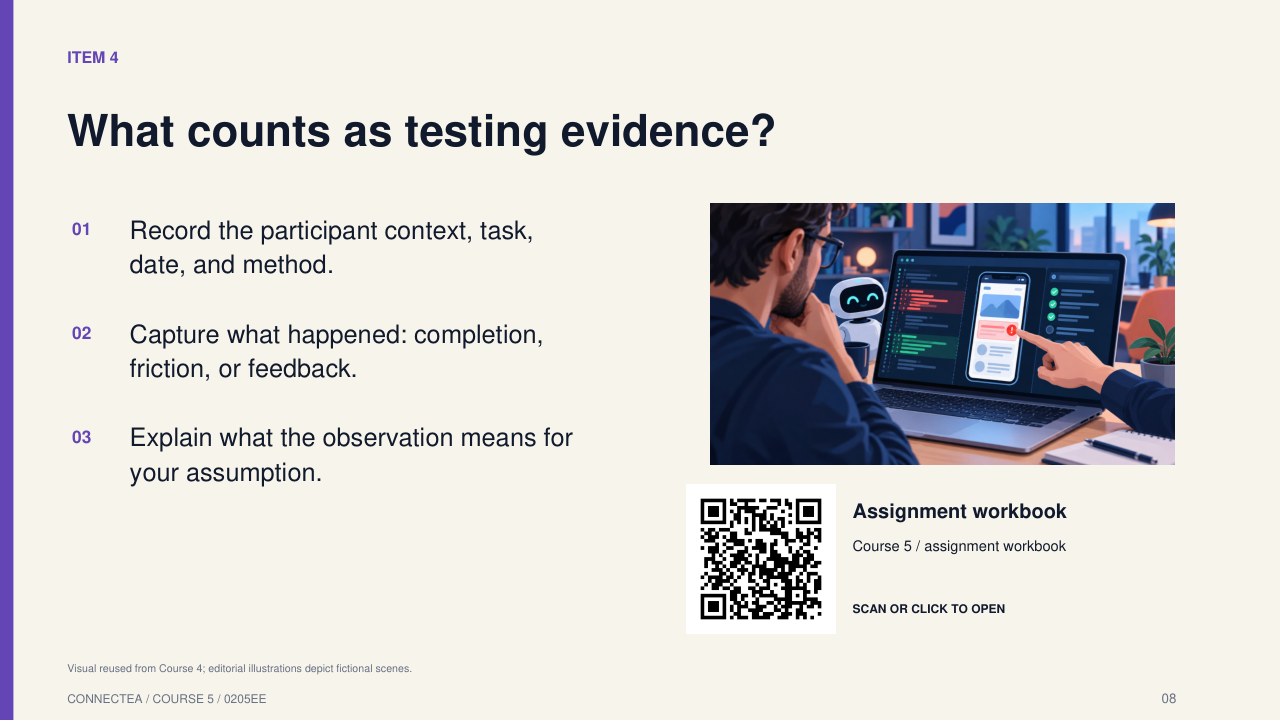
08 / ITEM 4
What counts as testing evidence?
- Record the participant context, task, date, and method.
- Capture what happened: completion, friction, or feedback.
- Explain what the observation means for your assumption.
Teaching notes
Fictional illustration: three volunteer shoppers tested the enquiry form; two missed the submit button. Keep this labelled as a teaching example. In real portfolios, use anonymised notes and relevant screenshots or recordings with permission. Separate user observations from your interpretation.
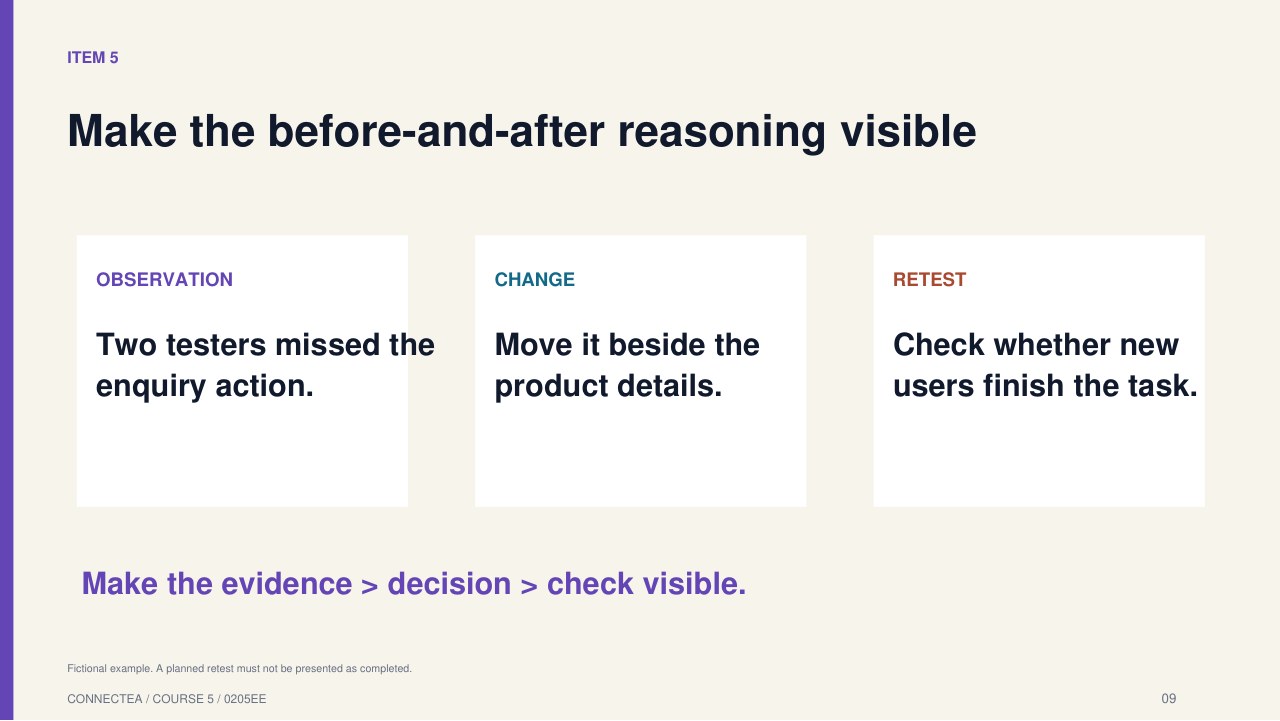
09 / ITEM 5
Make the before-and-after reasoning visible
- Before: users could not see what happens after submitting.
- Change: explain the reply process beside the form.
- Retest: check whether users can describe the next step.
Teaching notes
This is a fictional example, not a proven conversion improvement. Ask: what observation justified the change, what exactly changed, and how was it checked? If a retest has not happened, label it planned. Cosmetic changes can be useful, but the evidence must explain the decision.
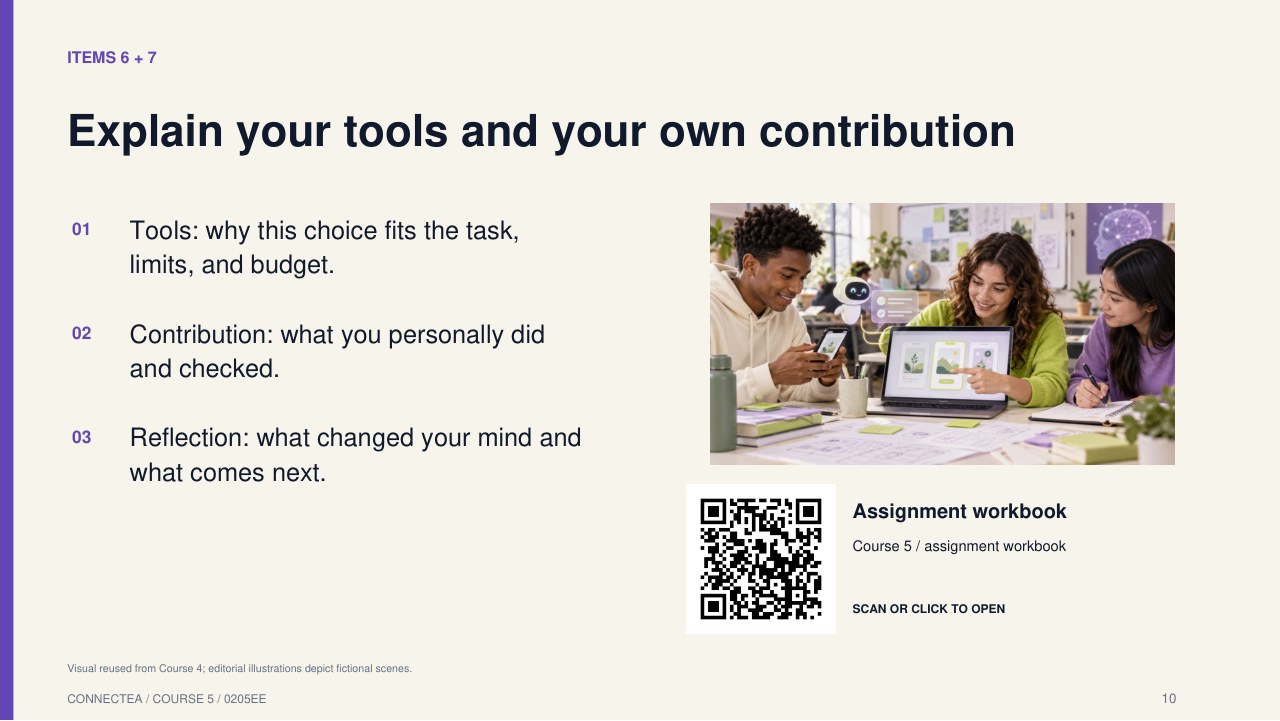
10 / ITEMS 6 + 7
Explain your tools and your own contribution
- Tools: why this choice fits the task, limits, and budget.
- Contribution: what you personally did and checked.
- Reflection: what changed your mind and what comes next.
Teaching notes
Weak: we used AI because it is fast. Stronger: AI drafted three form labels; I checked them with two users and chose the clearest. Team work can share project evidence, but each student must identify their own contribution and reflective learning. Do not invent participation.
11 / ITEM 8
Your ad should lead somewhere useful
- Name the audience, value promise, and next action.
- Include the creative link and the advertisement copy.
- Make the landing page deliver the promise in the ad.
Teaching notes
Ad clicks and likes do not establish demand by themselves. A useful next step could be a product enquiry, trial, booking, or volunteer test signup. The ad is already required in the hub and has no extra grading weight. Check that the creative link opens for the reviewer.
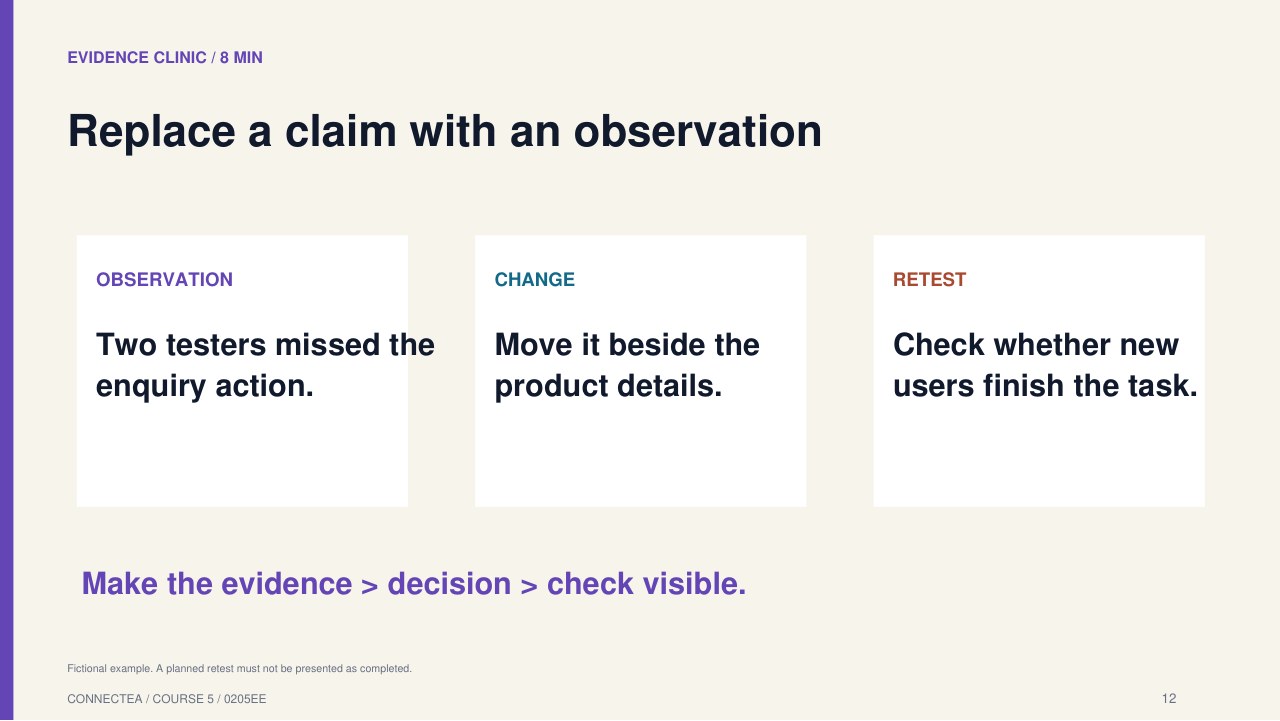
12 / EVIDENCE CLINIC / 8 MIN
Replace a claim with an observation
- Weak: everyone liked our website.
- Useful: 2 of 3 testers could not find the enquiry button.
- Action: improve its placement, then test the same task.
Teaching notes
All numbers on this slide are fictional. Pairs choose one vague statement from their own draft and rewrite it with actual evidence. If they have no evidence, write an honest test plan instead. Ask another pair to distinguish fact, interpretation, and next action.
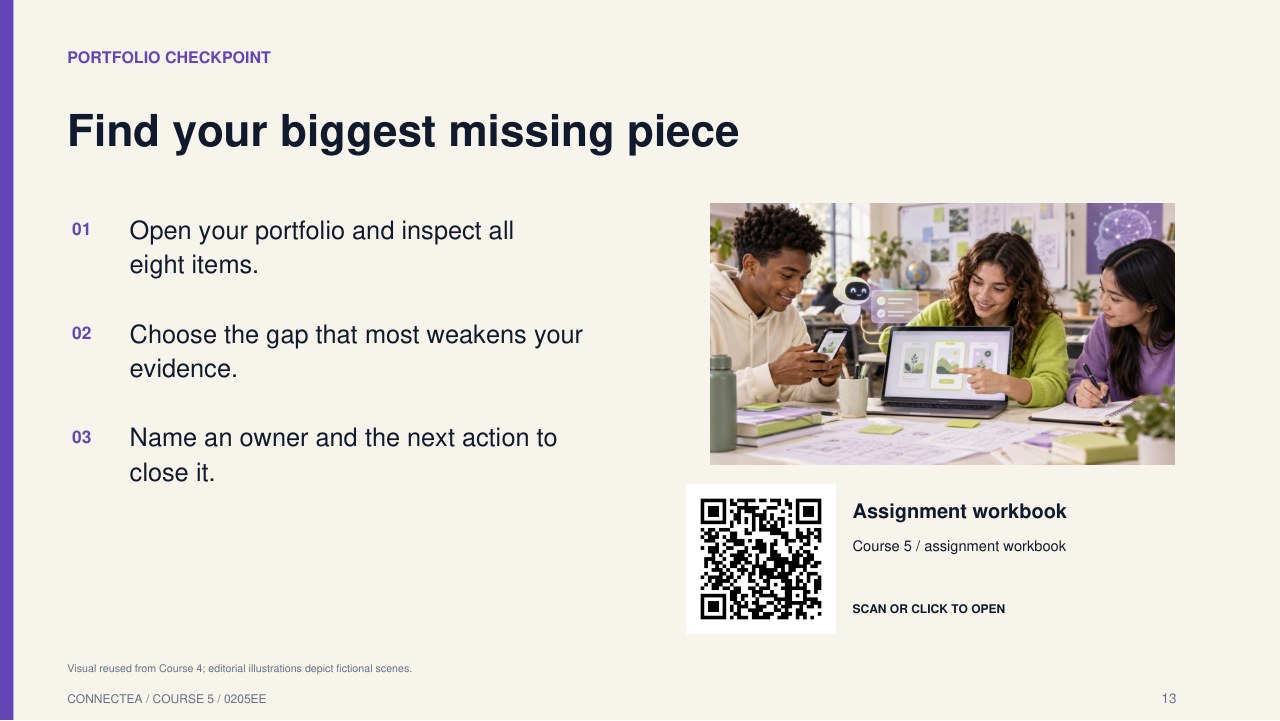
13 / PORTFOLIO CHECKPOINT
Find your biggest missing piece
- Open your portfolio and inspect all eight items.
- Choose the gap that most weakens your evidence.
- Name an owner and the next action to close it.
Teaching notes
Allow five minutes of individual work and a brief share-out. Ask students to explain what a reviewer could verify from their links. Assignment deadlines come from Google Classroom. Transition: the following customer work should help close a real evidence gap.
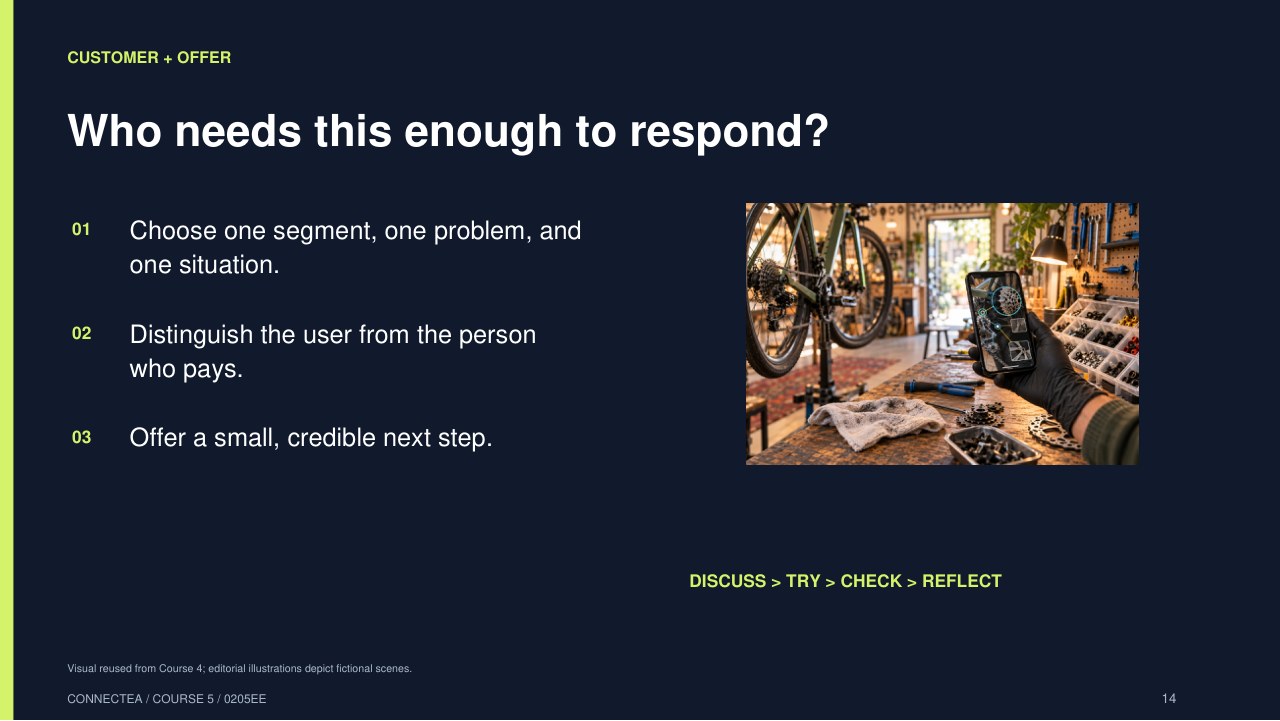
14 / CUSTOMER + OFFER
Who needs this enough to respond?
- Choose one segment, one problem, and one situation.
- Distinguish the user from the person who pays.
- Offer a small, credible next step.
Teaching notes
A segment should tell students where to look and why someone might care. Small businesses is too broad. Try independent shops in one area that receive repeated stock questions, then verify rather than assuming the problem.
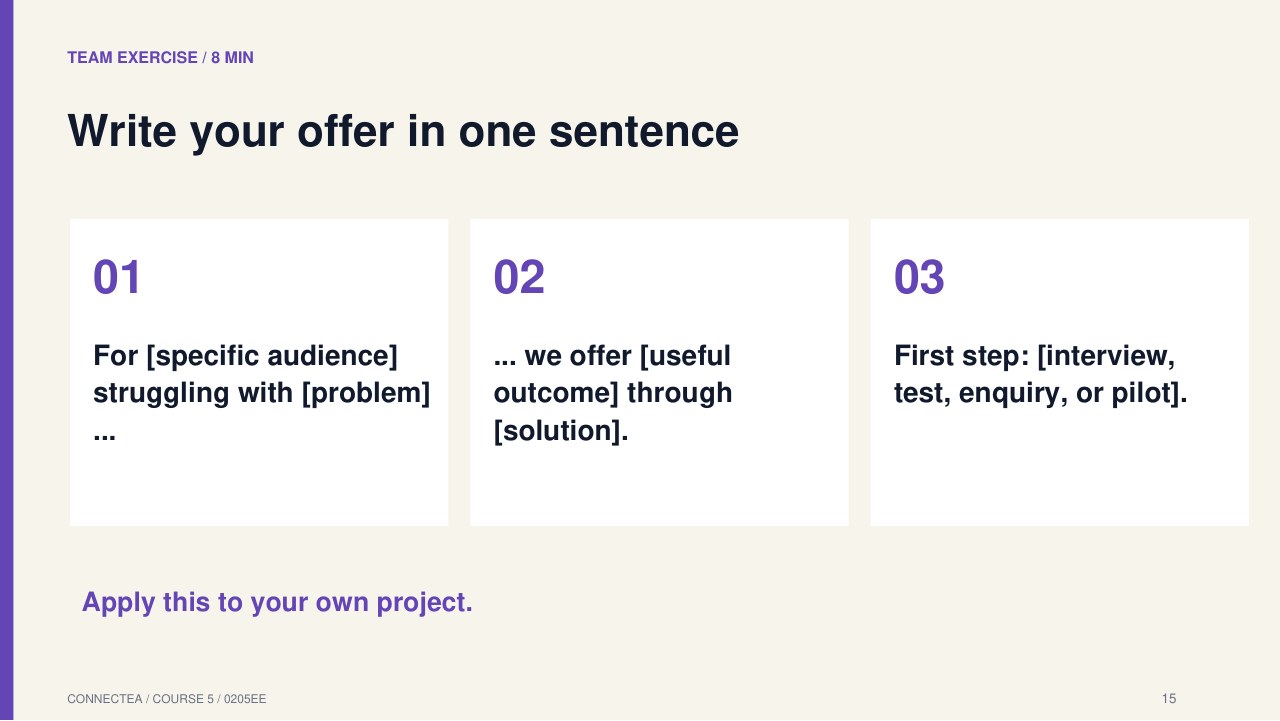
15 / TEAM EXERCISE / 8 MIN
Write your offer in one sentence
- For [specific audience] struggling with [problem] ...
- ... we offer [useful outcome] through [solution].
- First step: [interview, test, enquiry, or pilot].
Teaching notes
Ask teams to separate a sales invitation from a research invitation. If they are testing demand, do not pretend to have an established service. Pair review: could the other team name a plausible customer and understand the next action?
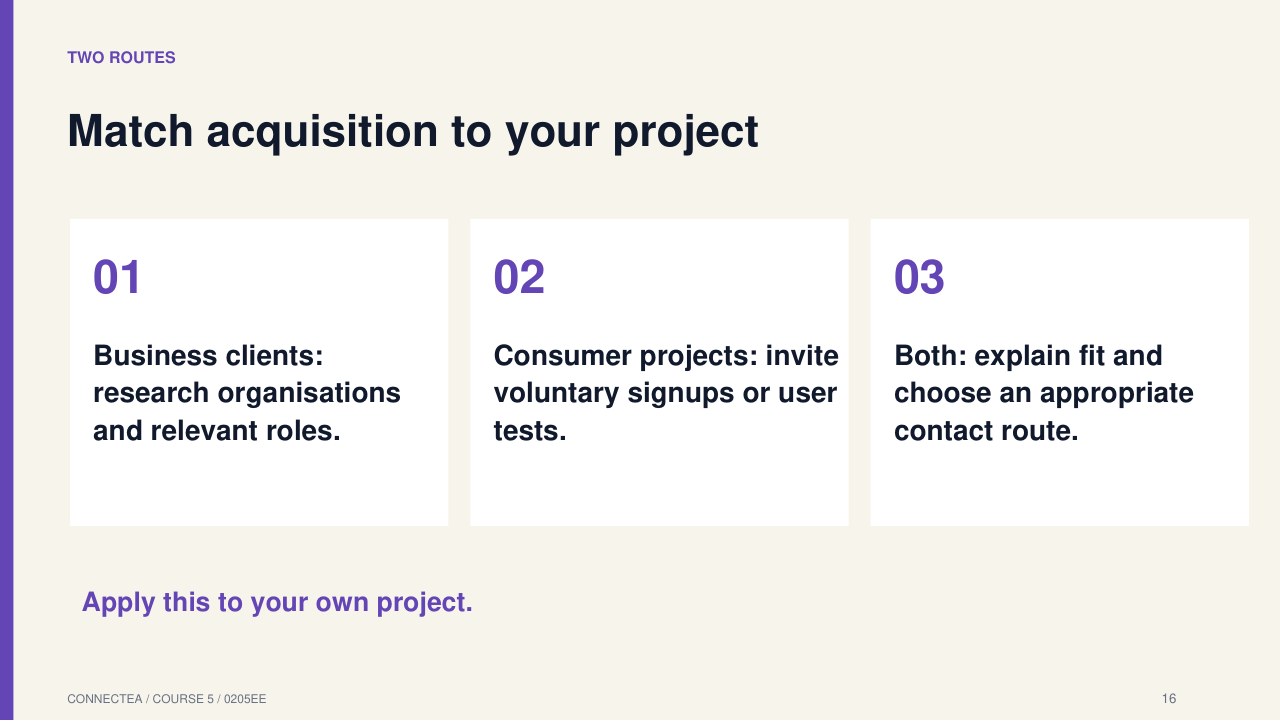
16 / TWO ROUTES
Match acquisition to your project
- Business clients: research organisations and relevant roles.
- Consumer projects: invite voluntary signups or user tests.
- Both: explain fit and choose an appropriate contact route.
Teaching notes
Use cohort examples as hypotheses. Inhousez or AT Media could investigate a defined business publishing need. ShopTruck could recruit prospective shoppers. Hoofin Around or Parelli could invite relevant learners. Ask MatPort to define its audience before choosing a channel.
17 / LEAD RESEARCH
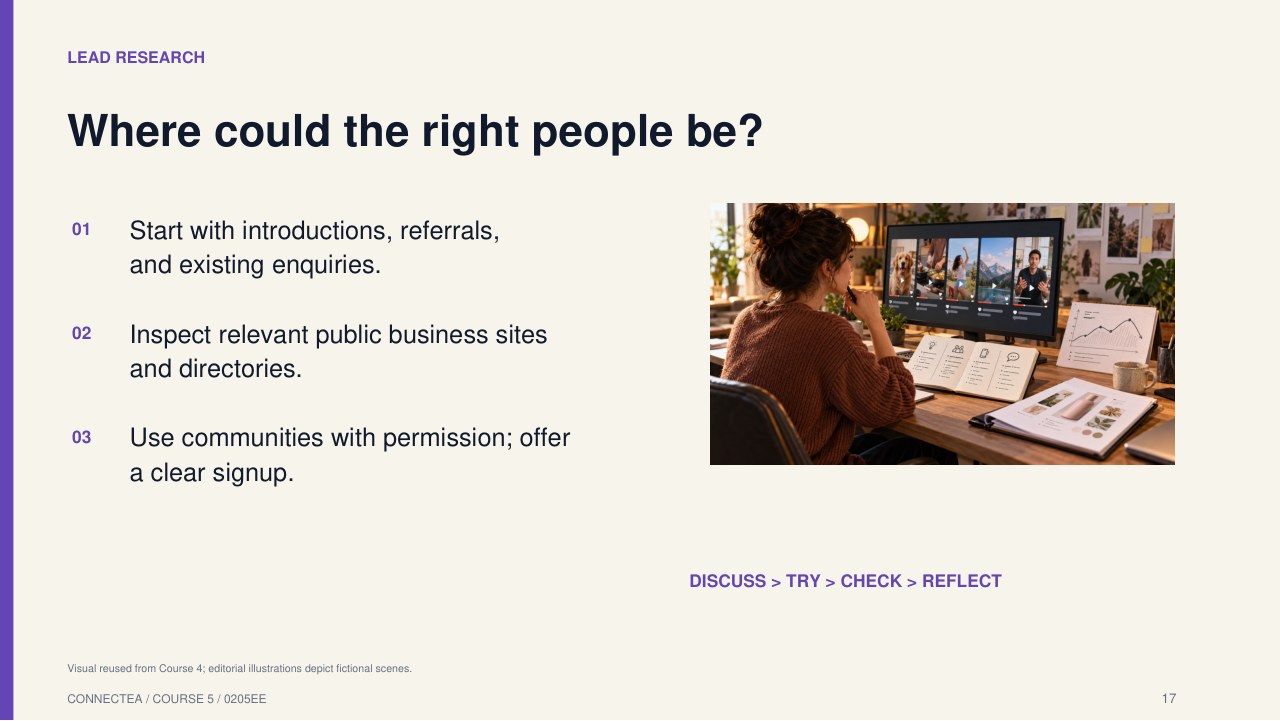
Where could the right people be?
- Start with introductions, referrals, and existing enquiries.
- Inspect relevant public business sites and directories.
- Use communities with permission; offer a clear signup.
Teaching notes
Choose one route per team. Lead gathering is not a contest to collect addresses. A publicly visible contact detail does not by itself establish permission for marketing. Keep classroom activity to research and drafts unless the team has an appropriate basis and channel for live outreach.
18 / LEAD QUALITY
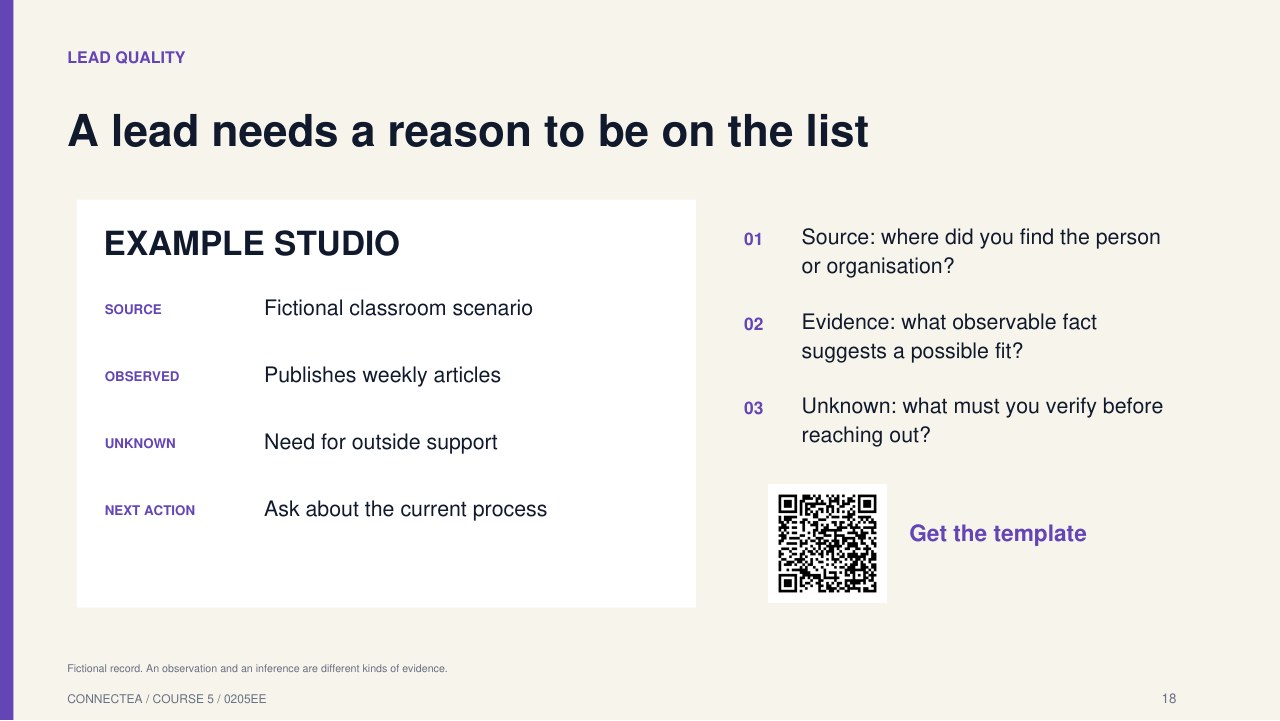
A lead needs a reason to be on the list
- Source: where did you find the person or organisation?
- Evidence: what observable fact suggests a possible fit?
- Unknown: what must you verify before reaching out?
Teaching notes
Fictional example: a studio publishes weekly articles; its page invites business enquiries. That is observable. It needs our AI service is an assumption. Record the source URL and date checked. Reject candidates that have no connection to the customer profile.
19 / AI RESEARCH
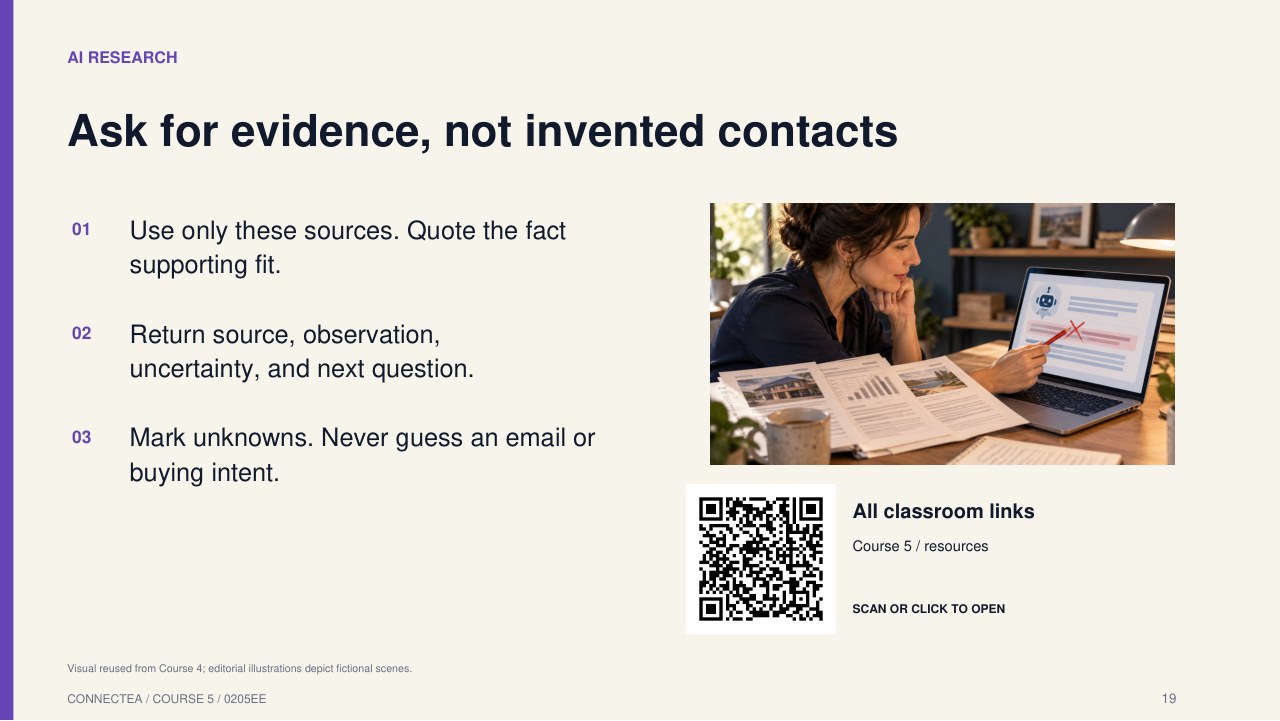
Ask for evidence, not invented contacts
- Use only these sources. Quote the fact supporting fit.
- Return source, observation, uncertainty, and next question.
- Mark unknowns. Never guess an email or buying intent.
Teaching notes
Demonstrate with a prepared public source or fictional sample. Have a student check each claim against the source. Avoid promising that an AI tool can discover private contact details or infer budget reliably. Full reusable prompts are in the workbook.
20 / RESEARCH SPRINT / 15 MIN
Build five useful starting records
- Find five candidates, or a relevant opt-in recruitment route.
- For each, record evidence of fit and what is unknown.
- Peer-check the sources and reject weak matches.
Teaching notes
Five is a classroom practice target, not an official assignment quota. Consumer teams can document recruitment routes and use fictional records for CRM practice until volunteers sign up. Keep personal contact details out of shared classroom notes.
21 / BREAK / 10 MIN
Bring back one candidate worth discussing
- What makes this person or organisation relevant?
- What evidence do you have?
- What is the smallest sensible next step?
Teaching notes
Return at minute 100. Set up the fictional CRM sample while the class takes a break. Do not spend the workshop creating multiple tool accounts.
22 / CRM BASICS
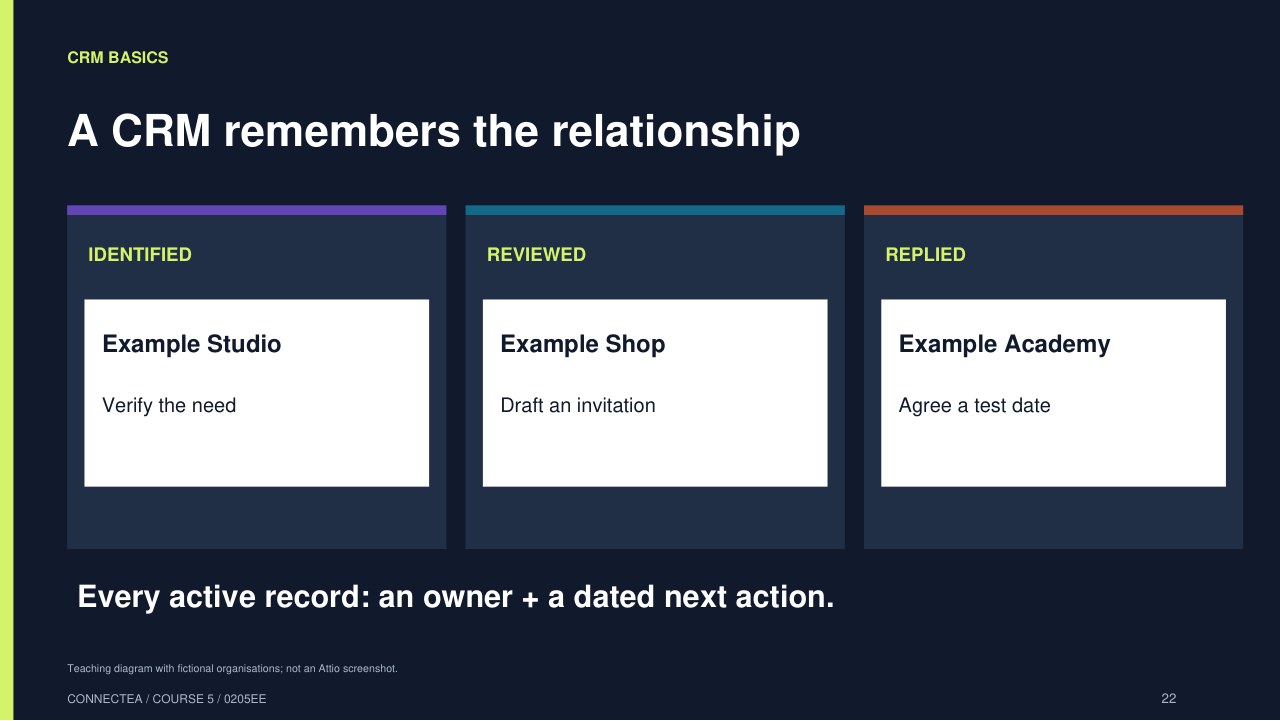
A CRM remembers the relationship
- Customer relationship management: a shared record.
- Who are we talking to, and what happened?
- Who owns the next action, and when is it due?
Teaching notes
Start with the downloadable CSV in a spreadsheet students already use. A dedicated CRM can come later when needed. The learning objective is a reliable process, not memorising a vendor interface. Explain contact, activity, and opportunity as different concepts.
23 / TOOL MAP
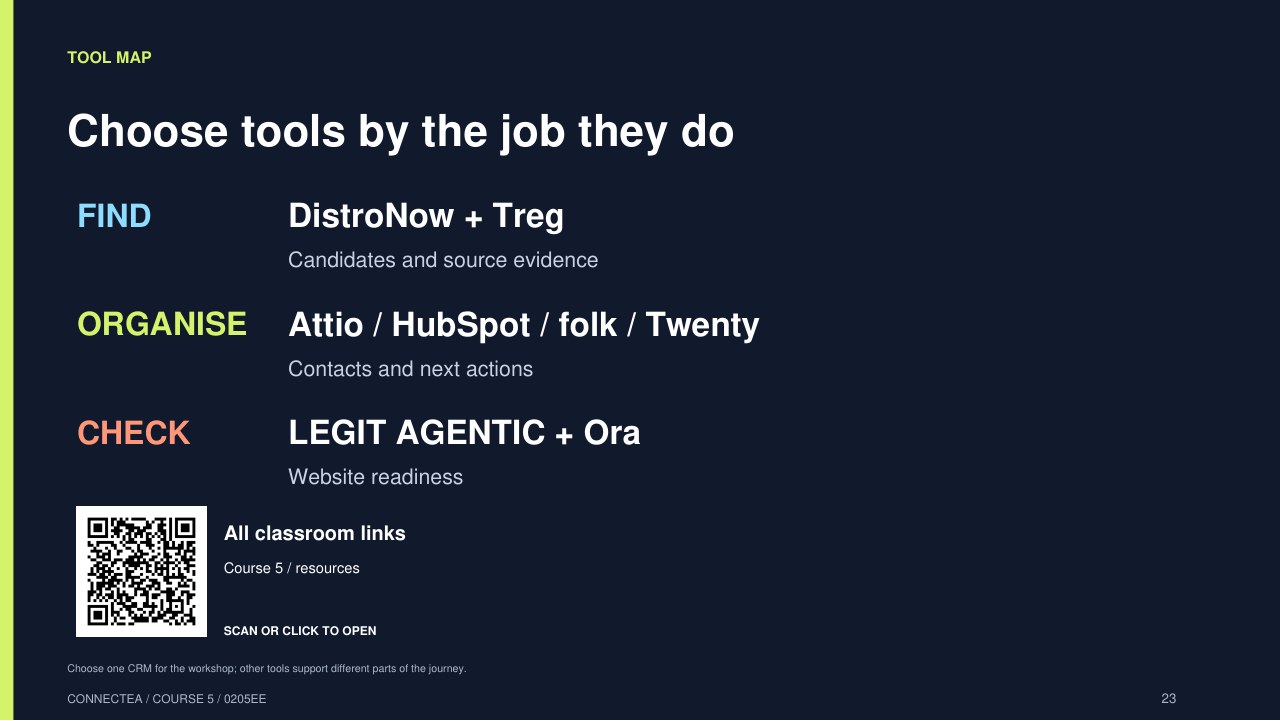
Choose tools by the job they do
- CRM: Attio, HubSpot, folk, or Twenty.
- Lead workflow: DistroNow; data access: Treg.
- Website checks: LEGIT AGENTIC and Ora.
Tool roles and verified sources
Teaching notes
Use one CRM for the exercise. The other tools serve different steps in acquisition. DistroNow is a repository-backed workflow, not a promise that every live integration is configured. Tool facts were reviewed on 5 October 2026; the tools guide links primary sources.
24 / CRM / CLASS DEFAULT
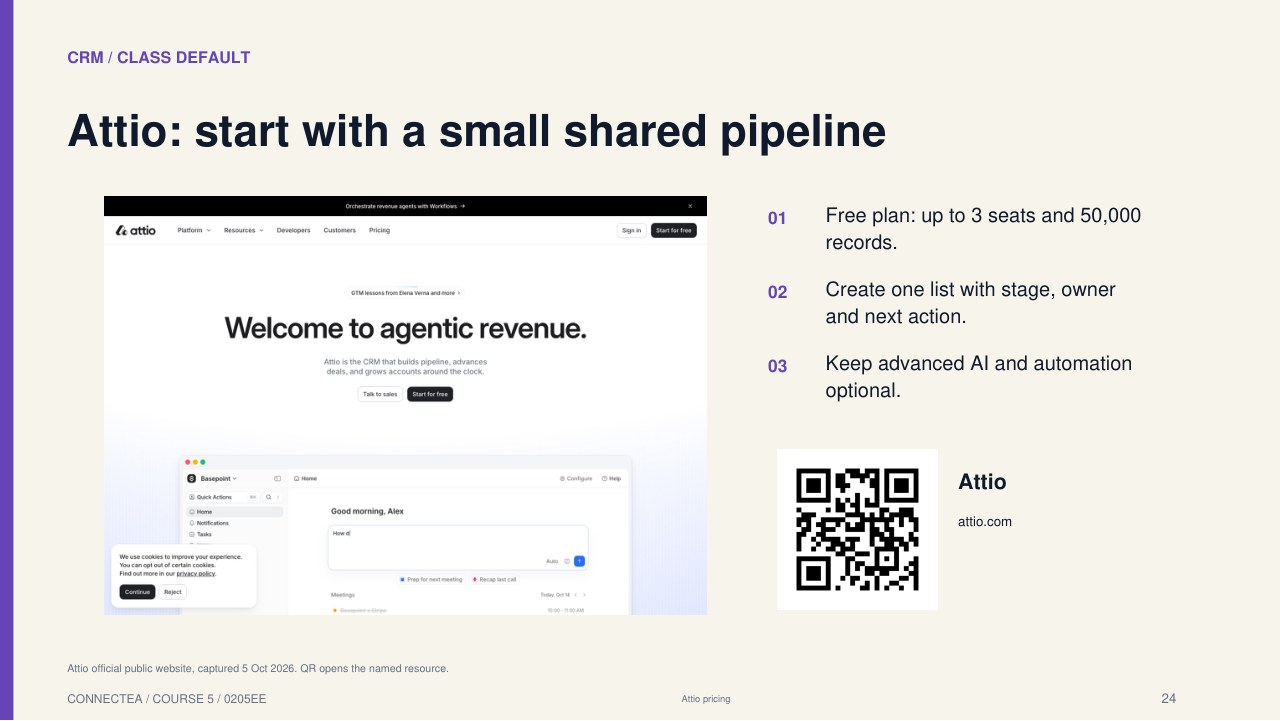
Attio: start with a small shared pipeline
- Free plan: up to 3 seats and 50,000 records.
- Create one list with stage, owner and next action.
- Keep advanced AI and automation optional.
Attio pricing
Teaching notes
Our recommendation is based on the small-team free plan and documented CSV import, not a comparative performance benchmark. Teams above three editors can use the spreadsheet exercise or another suitable plan; never share a login. Do not assume all AI features are included without limits.
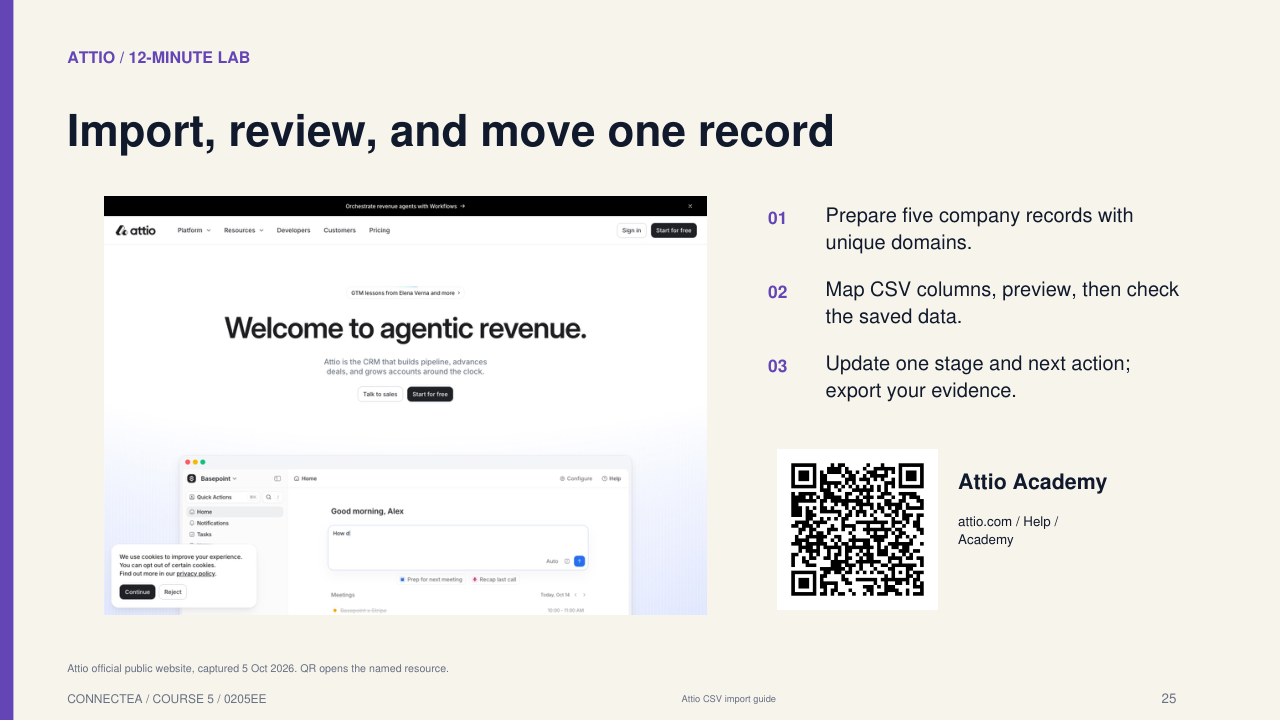
25 / ATTIO / 12-MINUTE LAB
Import, review, and move one record
- Prepare five company records with unique domains.
- Map CSV columns, preview, then check the saved data.
- Update one stage and next action; export your evidence.
Attio CSV import guide
Teaching notes
Use the dedicated fictional companies CSV in the tools guide, not real inbox data. Company name maps to Name and domain to Domains; list attributes hold source, fit evidence, stage, next action and due date. Add an actual teammate as owner after import. Confirm current import permissions. All .example domains are fictional; do not send or enrich them. Documentation-backed steps have not been tested in an authenticated Attio account.
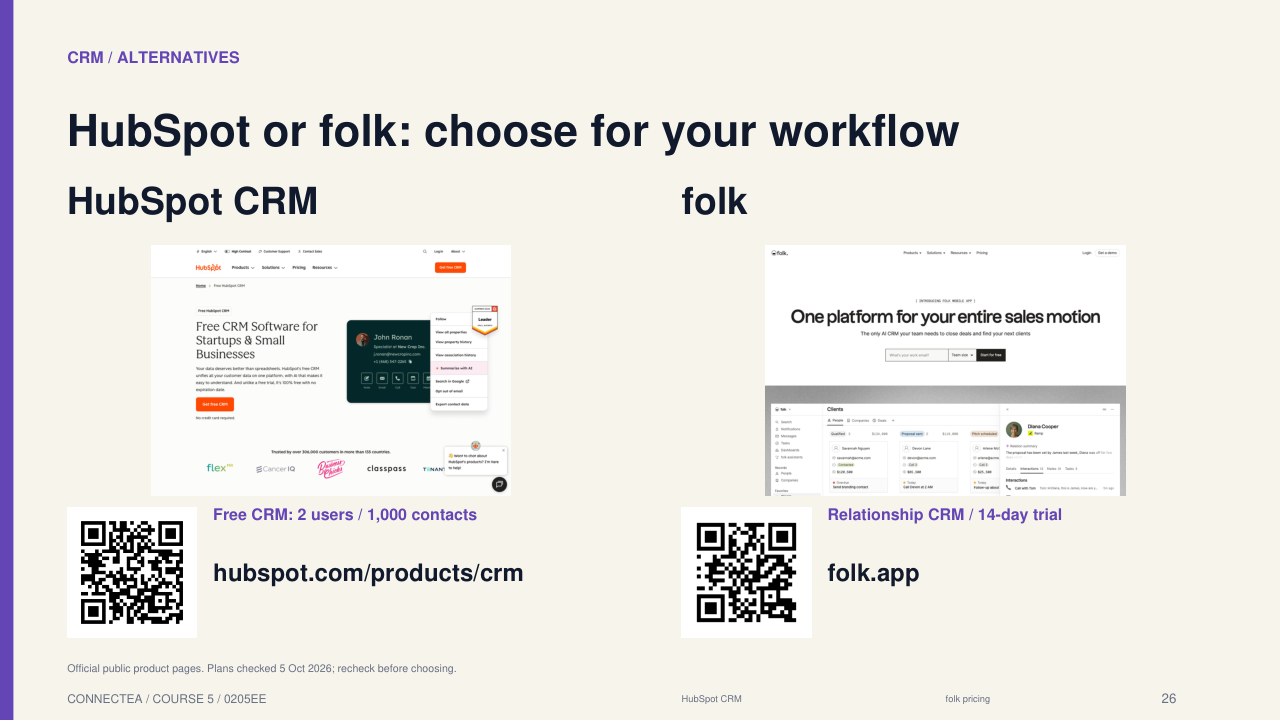
26 / CRM / ALTERNATIVES
HubSpot or folk: choose for your workflow
- HubSpot Free: 2 users, 1,000 contacts, deals and tasks.
- folk: relationship workflows and a 14-day trial.
- folk Standard: $30 monthly per member; paid after trial.
HubSpot CRM · folk pricing
Teaching notes
folk lists $24/member/month with annual billing. HubSpot suits students who want a broader familiar CRM ecosystem; folk is a useful agency example. These are teaching judgements. Premium folk features such as API access and sequences should not be assumed in Standard. Follow the source links for current limits.
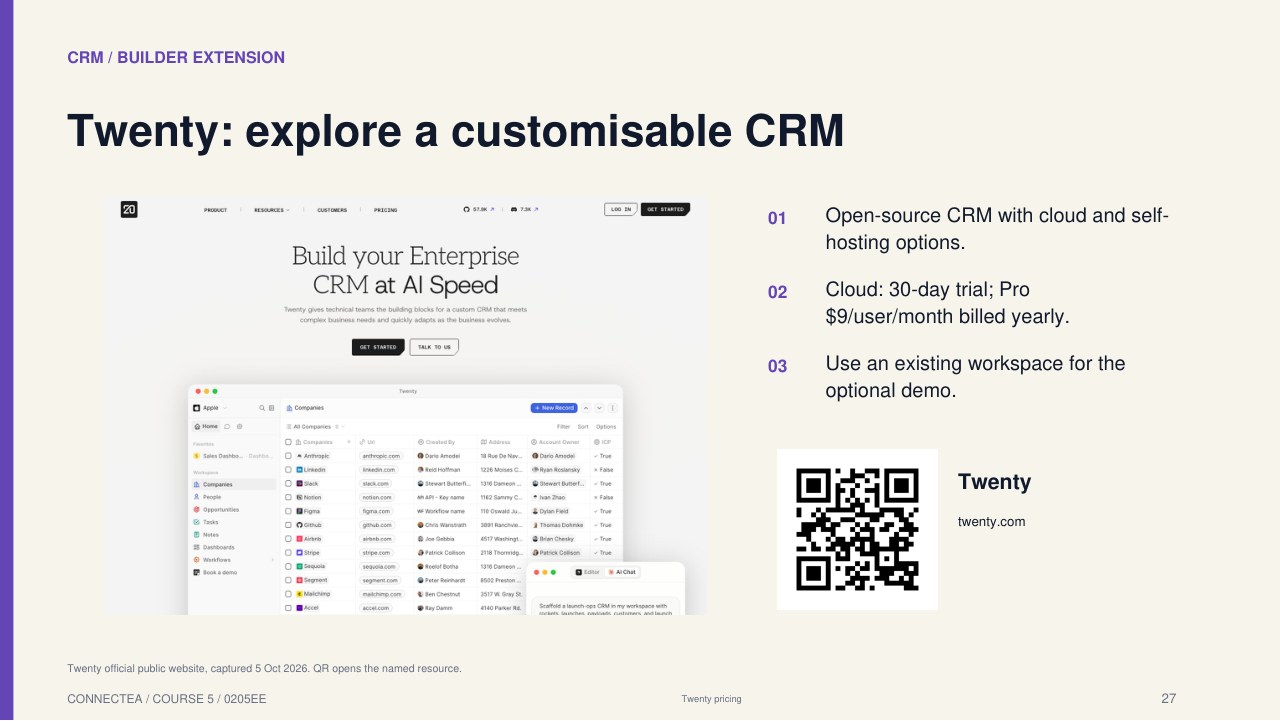
27 / CRM / BUILDER EXTENSION
Twenty: explore a customisable CRM
- Open-source CRM with cloud and self-hosting options.
- Cloud: 30-day trial; Pro $9/user/month billed yearly.
- Use an existing workspace for the optional demo.
Twenty pricing
Teaching notes
The pricing FAQ states the annual Cloud Pro price. Self-hosting requires operations work and is not equivalent to a no-cost hosted classroom account. Its published cloud offering includes an MCP server. Keep infrastructure setup outside the core lesson; the learning remains fields, stages and evidence.
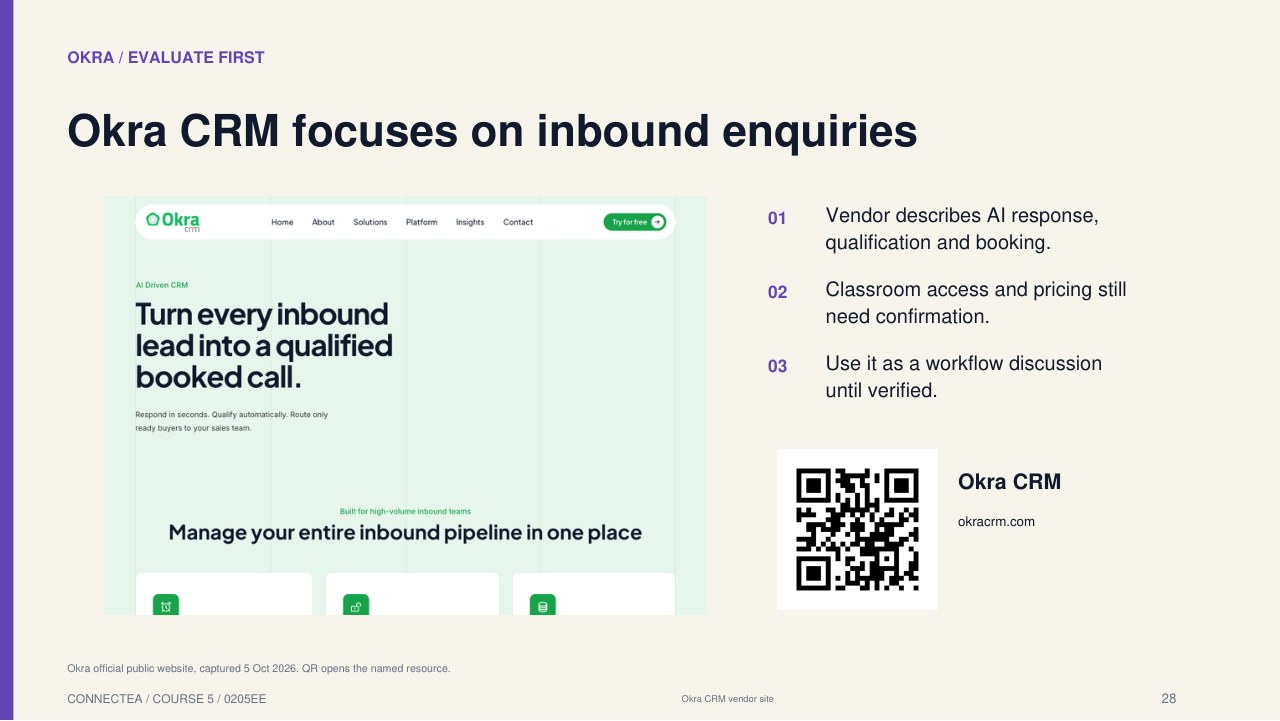
28 / OKRA / EVALUATE FIRST
Okra CRM focuses on inbound enquiries
- Vendor describes AI response, qualification and booking.
- Classroom access and pricing still need confirmation.
- Use it as a workflow discussion until verified.
Okra CRM vendor site
Teaching notes
Okra CRM exists at okracrm.com; it is distinct from Ora, referenced in LEGIT AGENTIC. Its site advertises trials but several plan/signup links lead to anchors and the pricing blocks are unclear. We have not validated a working account or its integration behaviour. Do not require students to buy it.
29 / YOUR STACK / DISTROnow
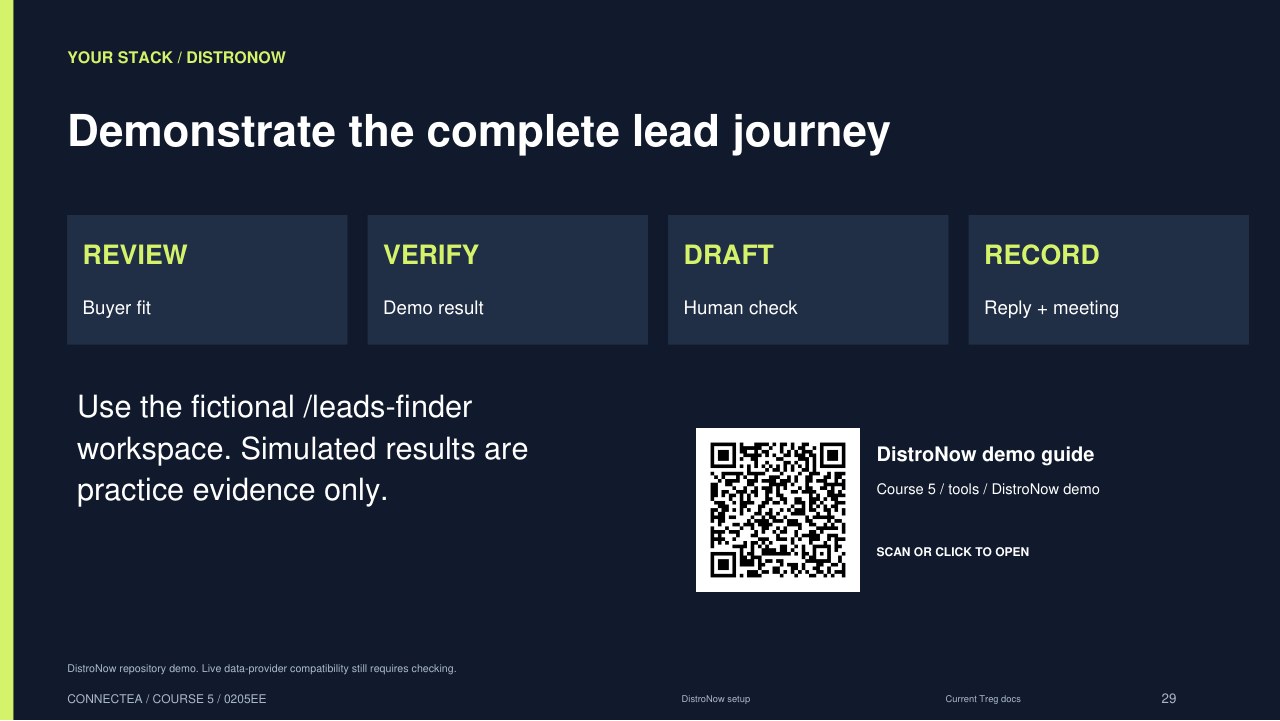
Demonstrate the complete lead journey
- Open the fictional /leads-finder demo.
- Review > verify > draft > approve > simulate send.
- Record a reply and meeting; inspect the activity evidence.
DistroNow setup · Current Treg docs
Teaching notes
DistroNow commit 4c4d7e9 documents a browser-local fictional demo with no discovery or sends. Use the instructor-provided app address; no public URL was verified. Live mode requires storage, provider and mailbox configuration. Current Treg docs differ from the repo contracts, so live discovery is an unverified extension. Simulated replies, meetings and revenue never count as actual portfolio validation.
30 / YOUR STACK / WEBSITE CHECK
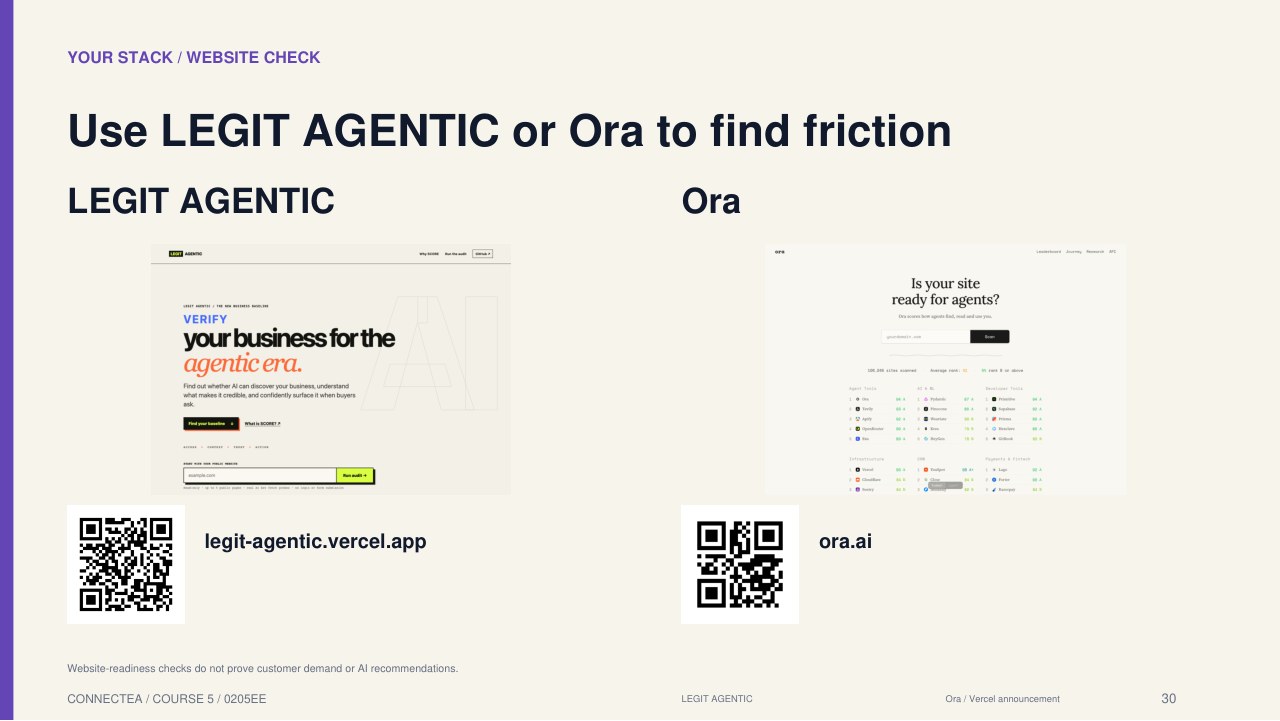
Use LEGIT AGENTIC or Ora to find friction
- Check whether the website is readable and usable.
- Choose one relevant issue and improve the prototype.
- Retest; explain the change in your portfolio.
LEGIT AGENTIC · Ora / Vercel announcement
Teaching notes
LEGIT AGENTIC distinguishes deterministic readiness checks from measured AI visibility. Ora is an agent-readiness platform and worked with Vercel on is-agentic. A higher readiness score does not prove recommendations, demand, or sales. Tie the audit to the user journey and include observed test evidence.
31 / PIPELINE
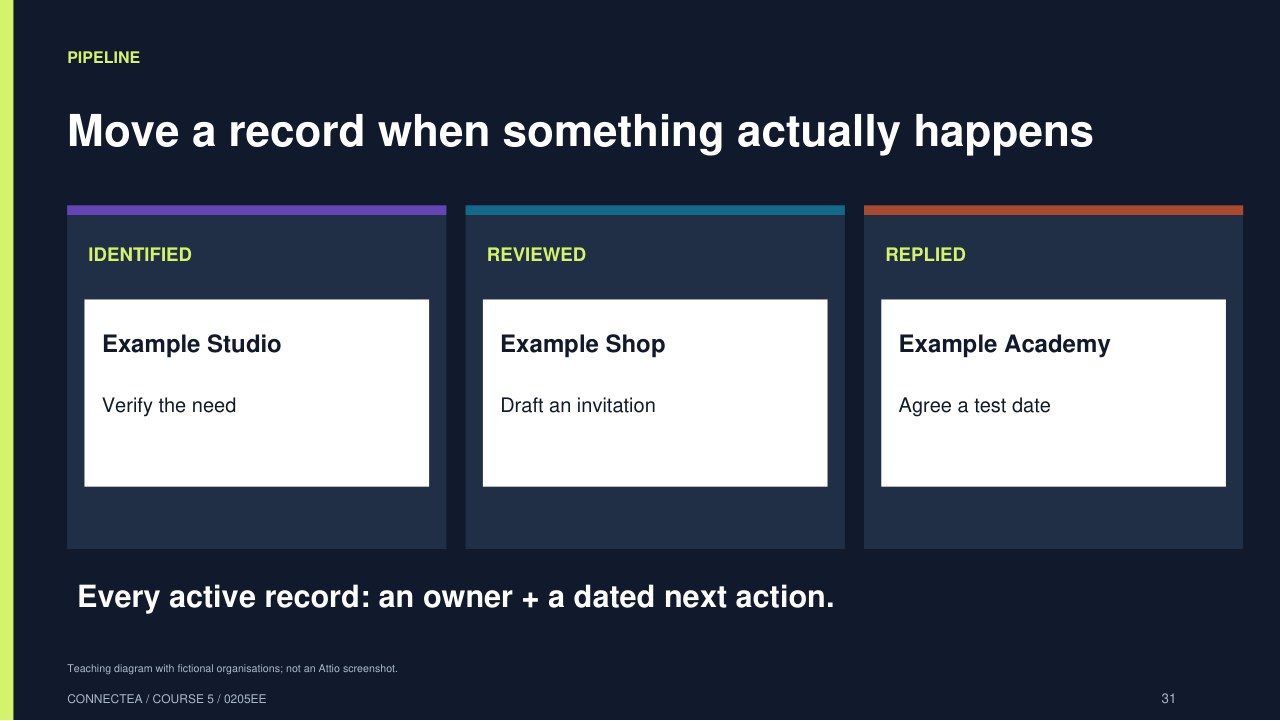
Move a record when something actually happens
- Identified > reviewed > contacted > replied.
- Discovery or test booked > offer or pilot > won / lost.
- Any stage can end in not a fit or do not contact.
Teaching notes
Contacted requires a sent message; replied requires an actual reply; won requires a real agreement. For validation projects use test completed and learning recorded instead of commercial closing. Do not advance stages because an AI score looks promising.
32 / MINIMUM RECORD
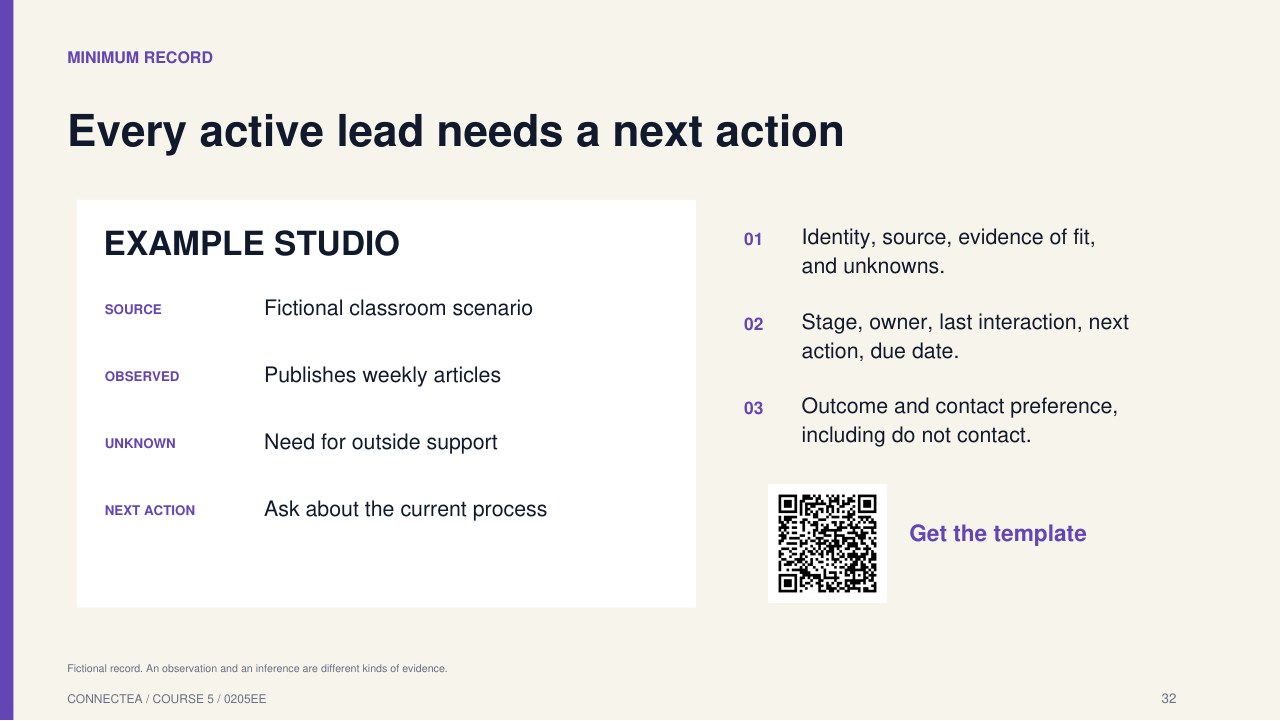
Every active lead needs a next action
- Identity, source, evidence of fit, and unknowns.
- Stage, owner, last interaction, next action, due date.
- Outcome and contact preference, including do not contact.
Teaching notes
Import the blank template. Show the fictional sample row marked DEMO. Dates in a real record must be actual dates. Minimise information collected. Do not put prospect data in the public repository or cohort-wide notes.
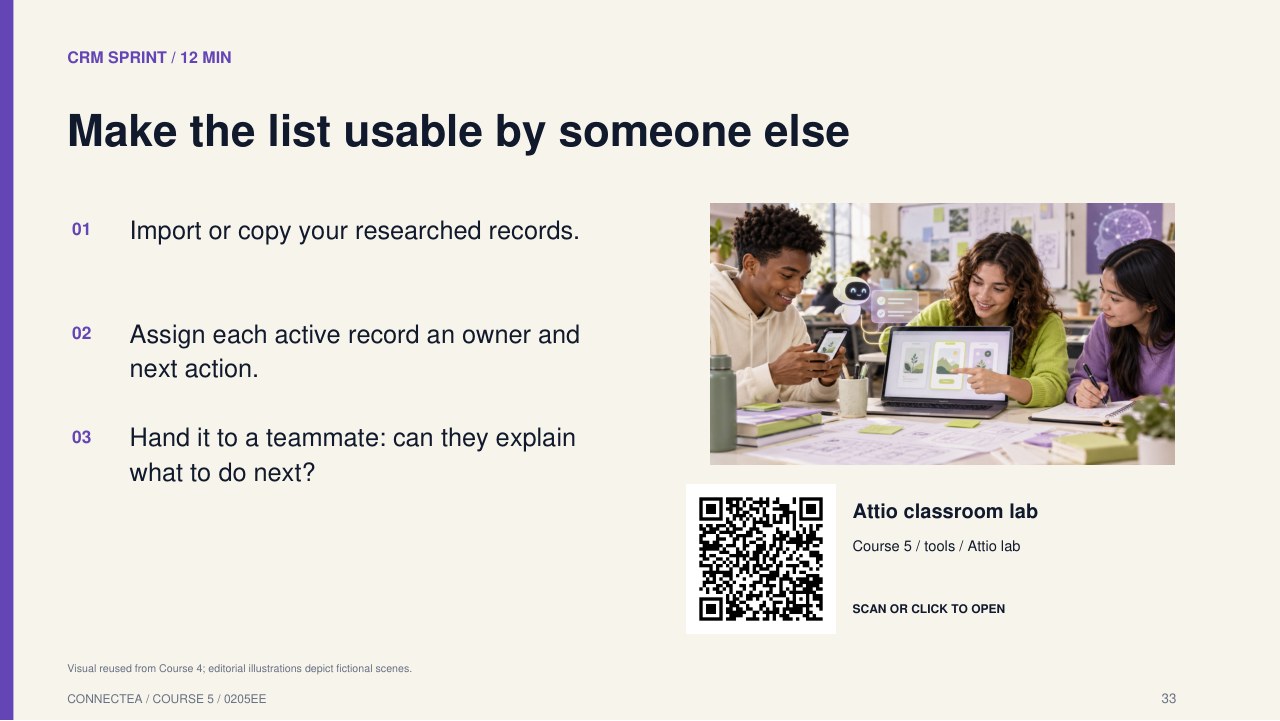
33 / CRM SPRINT / 12 MIN
Make the list usable by someone else
- Import or copy your researched records.
- Assign each active record an owner and next action.
- Hand it to a teammate: can they explain what to do next?
Teaching notes
Use the fictional sample if research produced no suitable candidates. Demonstrate a declined contact: mark do not contact and remove the follow-up task. This is a workflow exercise, not a new database feature in the course app.
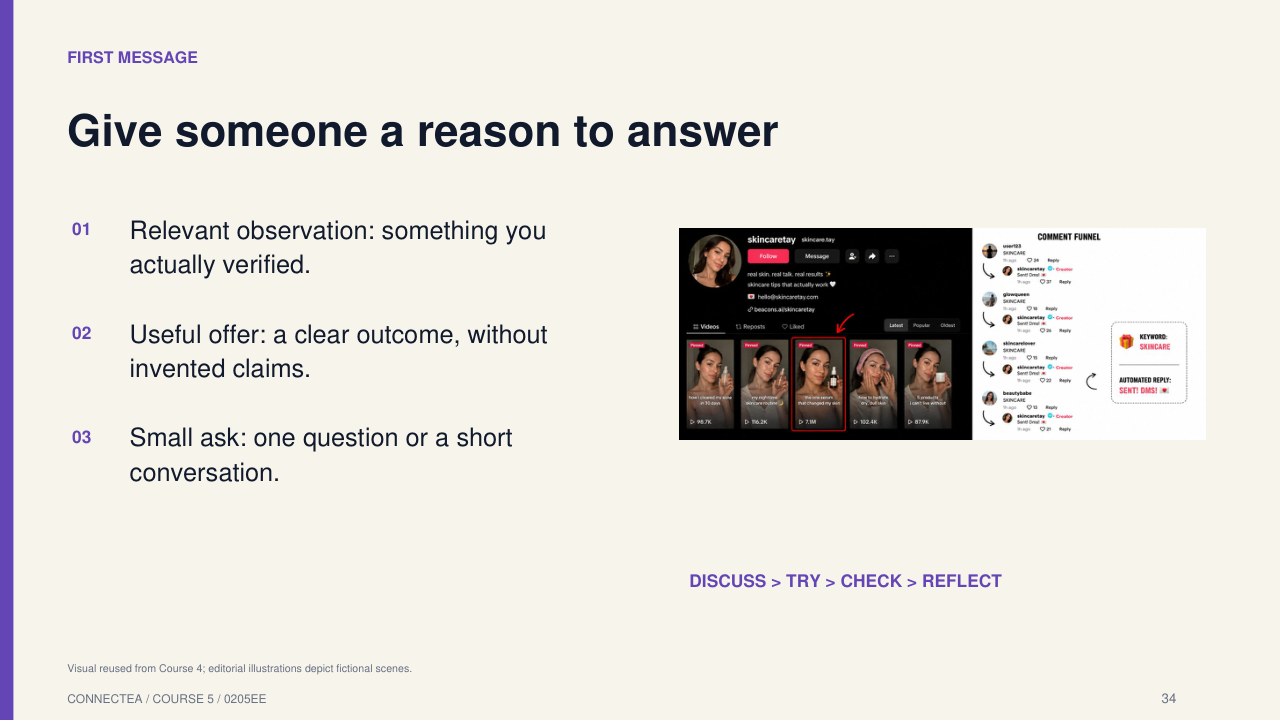
34 / FIRST MESSAGE
Give someone a reason to answer
- Relevant observation: something you actually verified.
- Useful offer: a clear outcome, without invented claims.
- Small ask: one question or a short conversation.
Teaching notes
Template: Hi [name], I noticed [verified observation]. We are testing [solution] for [audience]. Is [problem] something you encounter? If so, would a short conversation be useful? Review facts, tone, and contact appropriateness before sending.
35 / DISCOVERY
Learn about what already happens
- When did you last experience this problem?
- How did you handle it, and what was difficult?
- What would make trying a different approach worthwhile?
Teaching notes
Avoid would you buy my amazing product. Ask about actual situations and existing workarounds. Role-play for four minutes, switch roles, then identify one leading question. AI role-play is practice; it is not customer validation.
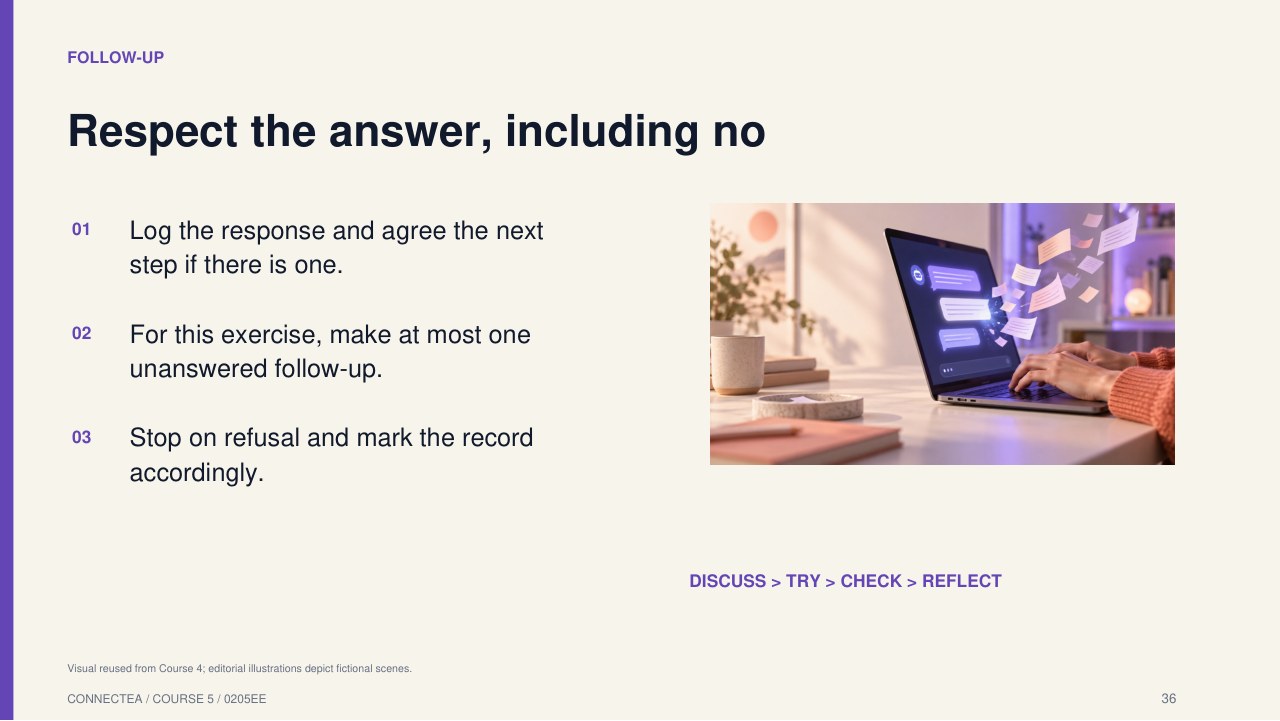
36 / FOLLOW-UP
Respect the answer, including no
- Log the response and agree the next step if there is one.
- For this exercise, make at most one unanswered follow-up.
- Stop on refusal and mark the record accordingly.
Teaching notes
This is a conservative classroom exercise rule, not a statement of law or a universal sales cadence. Choose appropriate channels and check applicable requirements before live outreach. Automate internal reminders before external messages. Never auto-send AI drafts.
37 / MESSAGE CLINIC / 8 MIN
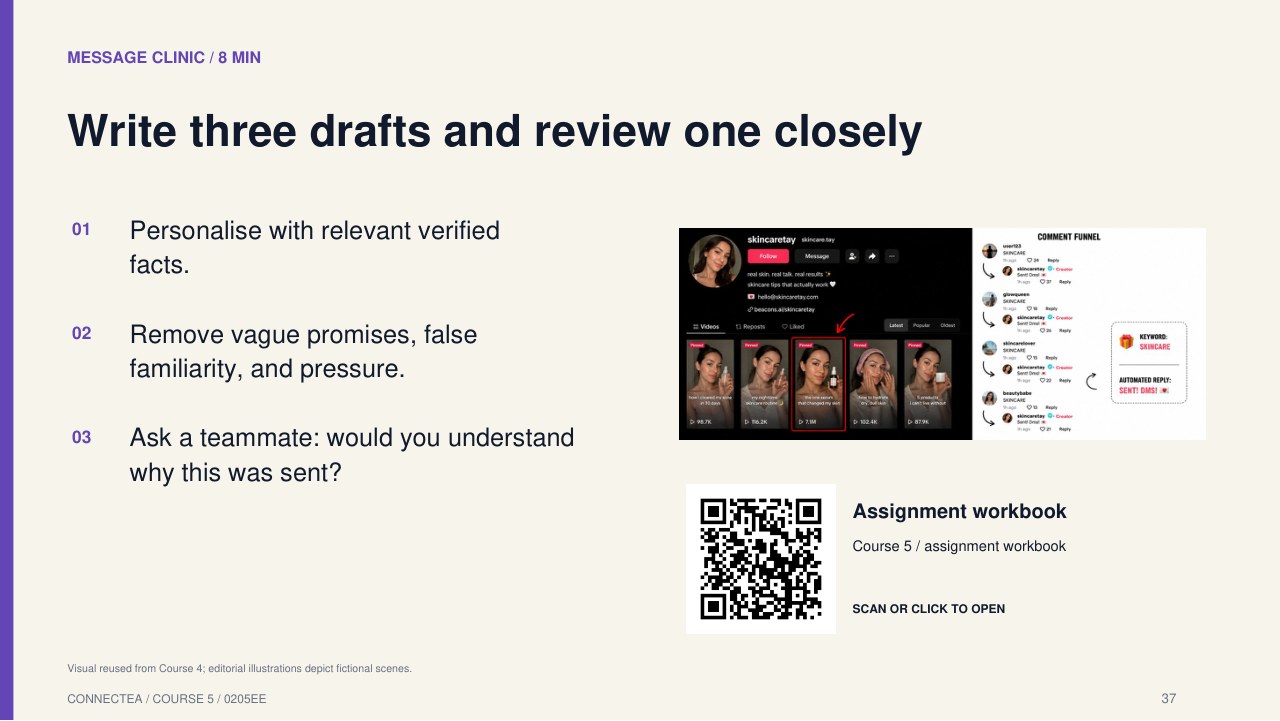
Write three drafts and review one closely
- Personalise with relevant verified facts.
- Remove vague promises, false familiarity, and pressure.
- Ask a teammate: would you understand why this was sent?
Teaching notes
Students can draft a research invitation, a service enquiry invitation, or a response to an inbound signup. The audience and context should determine the message. No requirement to contact real people during class.
38 / CAPTURE FLOW
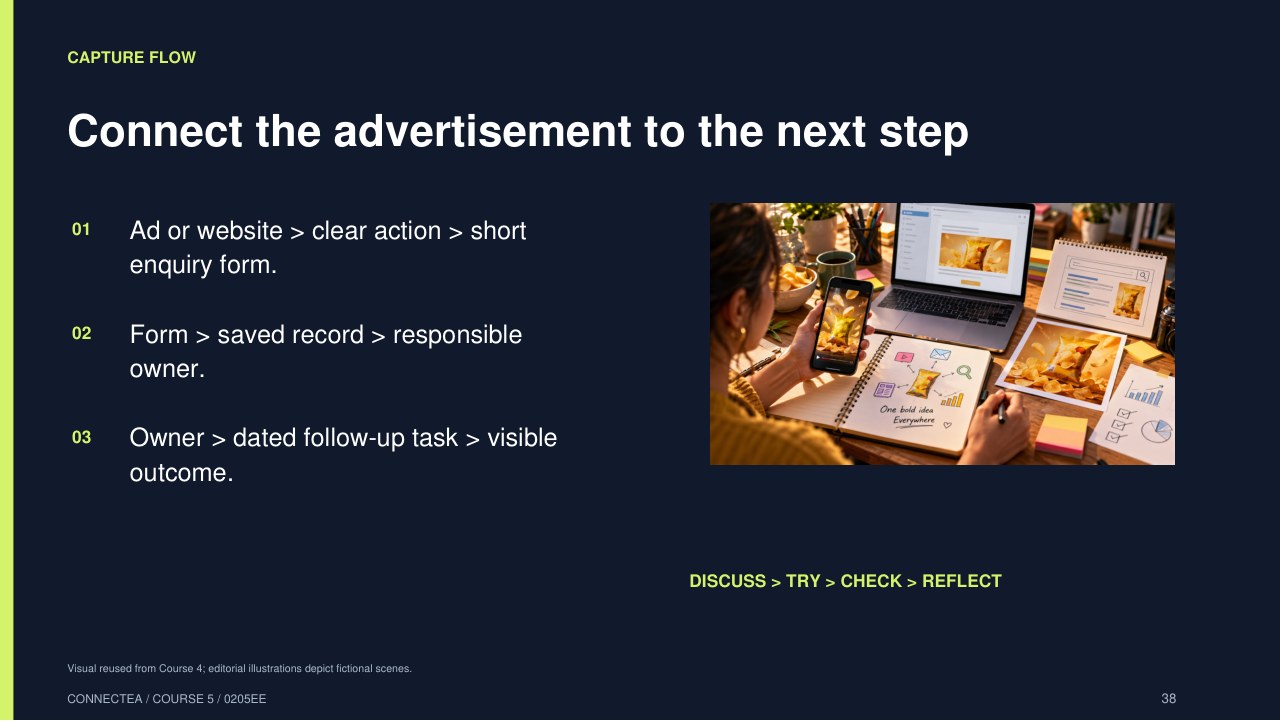
Connect the advertisement to the next step
- Ad or website > clear action > short enquiry form.
- Form > saved record > responsible owner.
- Owner > dated follow-up task > visible outcome.
Teaching notes
Use a fictional form submission for the demonstration. If there is no integration, a documented manual handoff is acceptable for the prototype. Do not claim a CRM integration exists unless students can demonstrate the saved record.
39 / CAPTURE TEST / 10 MIN
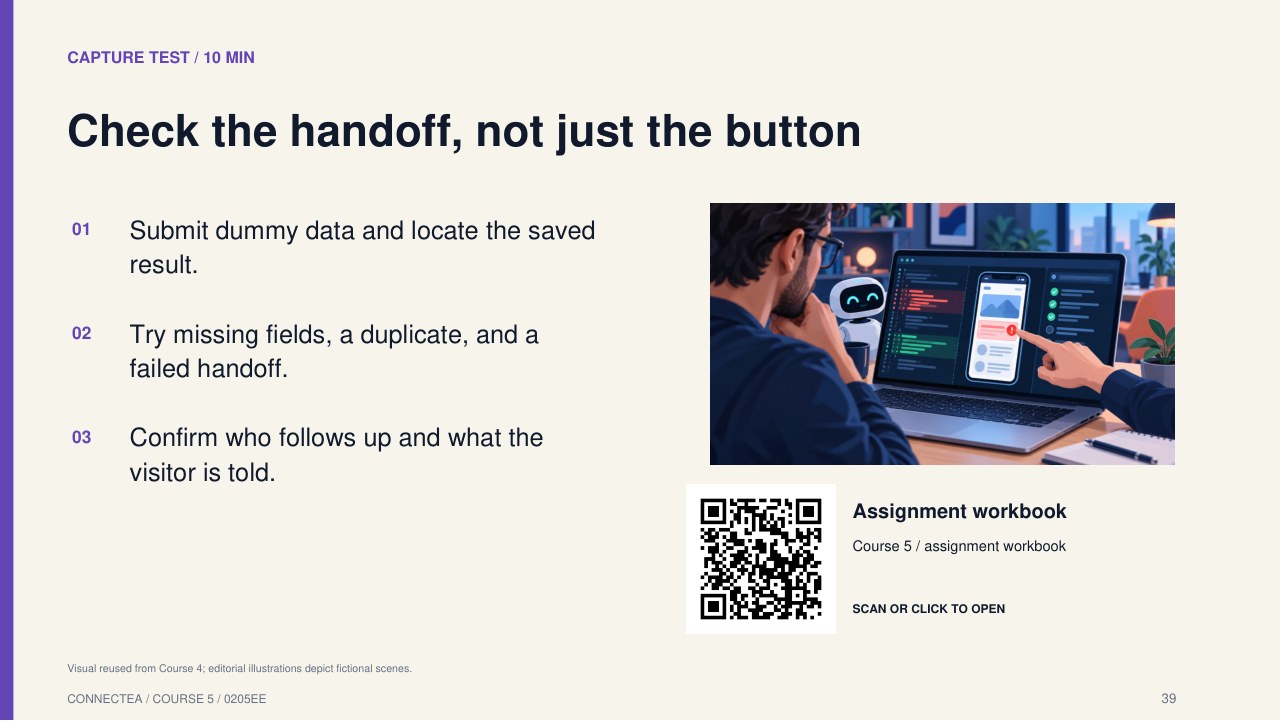
Check the handoff, not just the button
- Submit dummy data and locate the saved result.
- Try missing fields, a duplicate, and a failed handoff.
- Confirm who follows up and what the visitor is told.
Teaching notes
For a manual workflow, test the steps and ownership explicitly. Collect only needed information and explain the stated purpose. A failure should be visible and recoverable. Record observed behaviour rather than ticking success for an untested case.
40 / MEASUREMENT
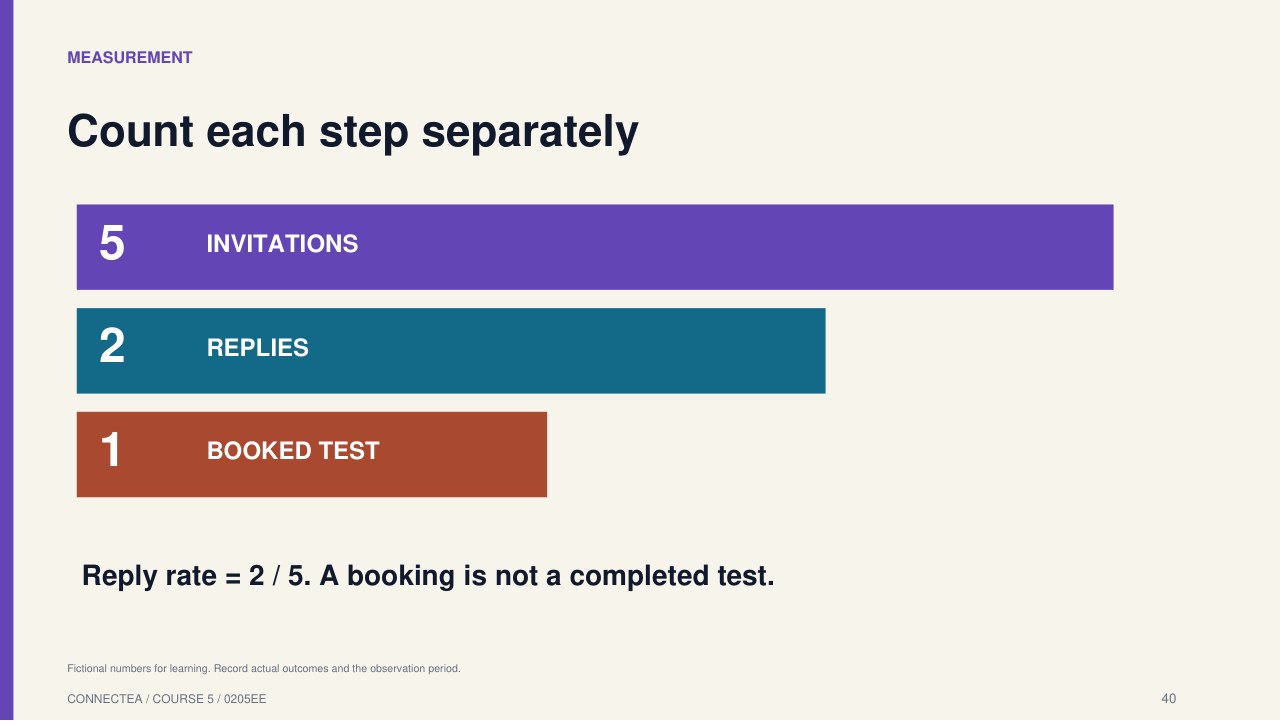
Count each step separately
- Researched, contacted, replied, booked, tested, won.
- Show numerator, denominator, and observation period.
- Small samples guide questions; they do not prove demand.
Teaching notes
Fictional example: five invitations, two replies, one booked test. Reply rate is 2/5, not 2/10 researched candidates. A booked test is not a completed test or a paying customer. Record zero honestly and investigate the cause.
41 / SEVEN-DAY EXPERIMENT
Decide what the evidence would change
- We believe [segment] experiences [problem].
- We will test [offer] through [appropriate channel].
- If [signal], we will [decision]; otherwise investigate [why].
Teaching notes
Suggest ten reviewed candidates or an opt-in route and five appropriate invitations, adaptable to the project. These are practice targets, not grading requirements. Define learning signals before acting; do not guarantee replies or sales. Let teams test their strongest remaining assumption.
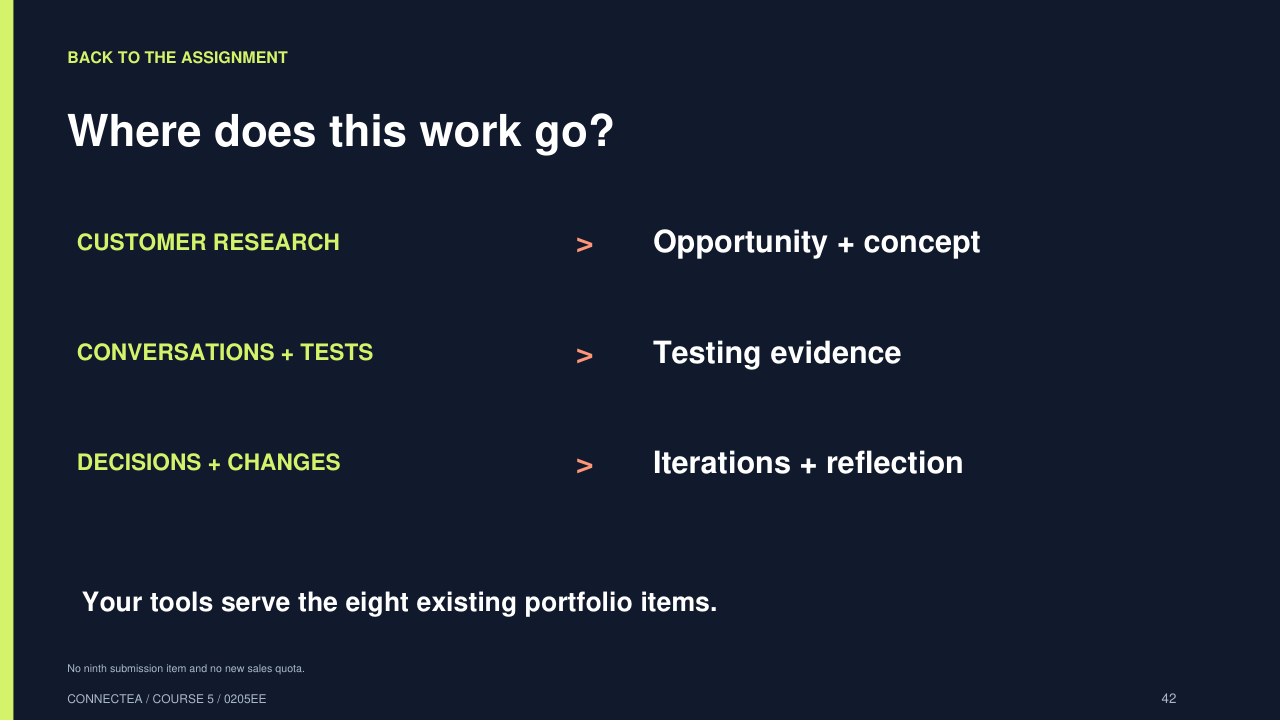
42 / BACK TO THE ASSIGNMENT
Where does this work go?
- Customer research strengthens opportunity and concept.
- CRM, conversations, and capture tests support testing.
- Changes, tool reasoning, and reflection complete the story.
Teaching notes
The advertisement still needs its creative link and copy, and the prototype still needs live and repository links. A list of contacts alone is not testing evidence. Show the existing portfolio fields; no separate CRM upload is mandatory.
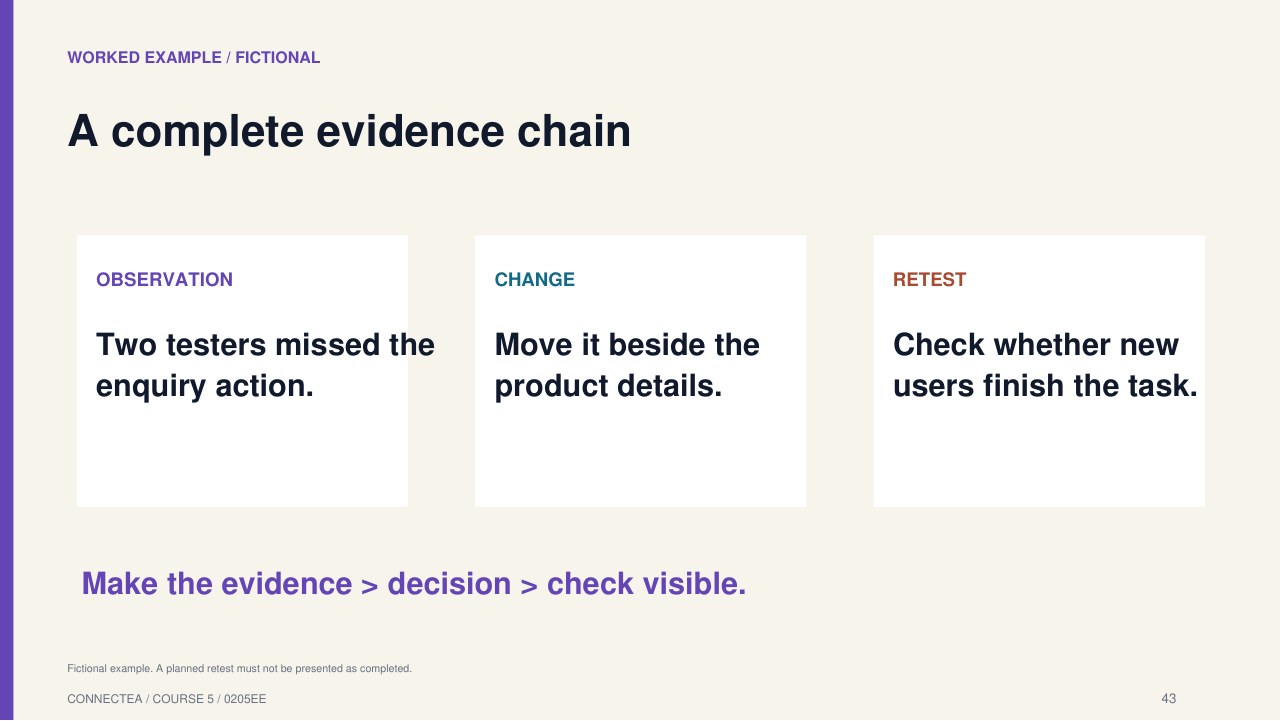
43 / WORKED EXAMPLE / FICTIONAL
A complete evidence chain
- Observation: two testers missed the enquiry action.
- Decision: move the action beside the product details.
- Retest: record whether new testers complete the task.
Teaching notes
Example portfolio paragraph: I observed two of three volunteer testers miss the enquiry action. I moved it beside the product details and added a confirmation message. My next test will check task completion and expectations about a reply. The retest is planned, not completed. Never copy these invented numbers into a real submission.
44 / INDIVIDUAL REFLECTION
Say what you did and what you learned
- I contributed [specific work] and checked [evidence].
- I expected [assumption], but observed [actual result].
- I changed [decision]; next I will test [remaining risk].
Teaching notes
Give a minute of silent writing. Strong reflection can include a failed test, an incorrect assumption, or a tool limitation. It should connect personal action to evidence and judgement. Shared project results do not replace an individual account.
45 / ASSESSMENT DISCUSSION
What makes a portfolio stronger?
- Functional prototype and basic evidence establish the base.
- Clear reasoning and evidence-led changes strengthen it.
- Robust validation and mature reflection support excellence.
Teaching notes
Refer to the official hub bands: 0.0-5.4 insufficient, 5.5-6.9 sufficient, 7.0-8.4 good, 8.5-10 excellent. These summaries are explanations, not a replacement rubric. More leads, more screenshots, or a sale alone do not establish a higher grade.
46 / PEER REVIEW / 8 MIN
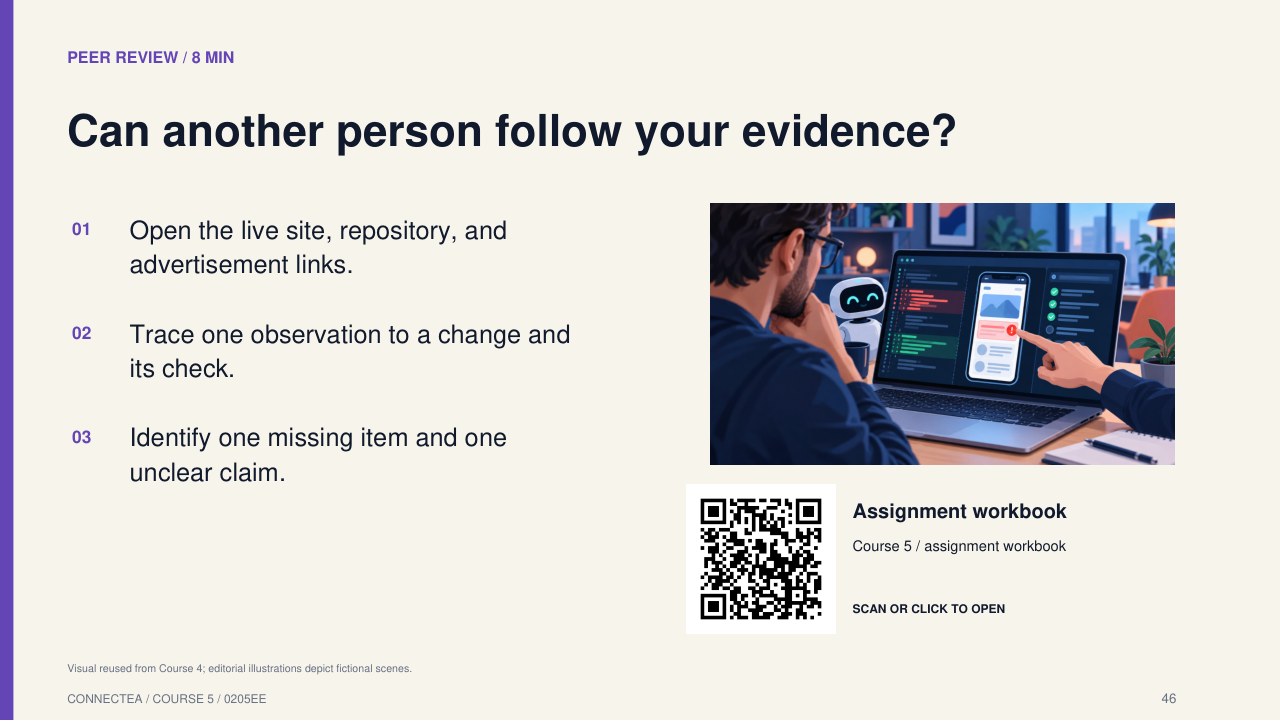
Can another person follow your evidence?
- Open the live site, repository, and advertisement links.
- Trace one observation to a change and its check.
- Identify one missing item and one unclear claim.
Teaching notes
Pairs review the eight-item checklist. Each student records one concrete improvement and its owner. Make sure private evidence is shared appropriately with the assessor rather than posted publicly. Allow time for questions about the actual assignment.
47 / ASSIGNMENT QUESTIONS
Resolve these before you submit
- No sales yet? Show honest testing, learning, and iteration.
- Worked as a team? Explain your individual contribution.
- No reply? Record it; investigate fit, channel, and offer.
Teaching notes
Also clarify: no customer interviews yet means the team needs a test plan and actual validation evidence before claiming completion. AI simulations cannot stand in for real users. A CRM screenshot alone is insufficient. Deadlines and exam chances remain in Google Classroom; do not invent dates.
48 / LEAVE WITH A NEXT STEP
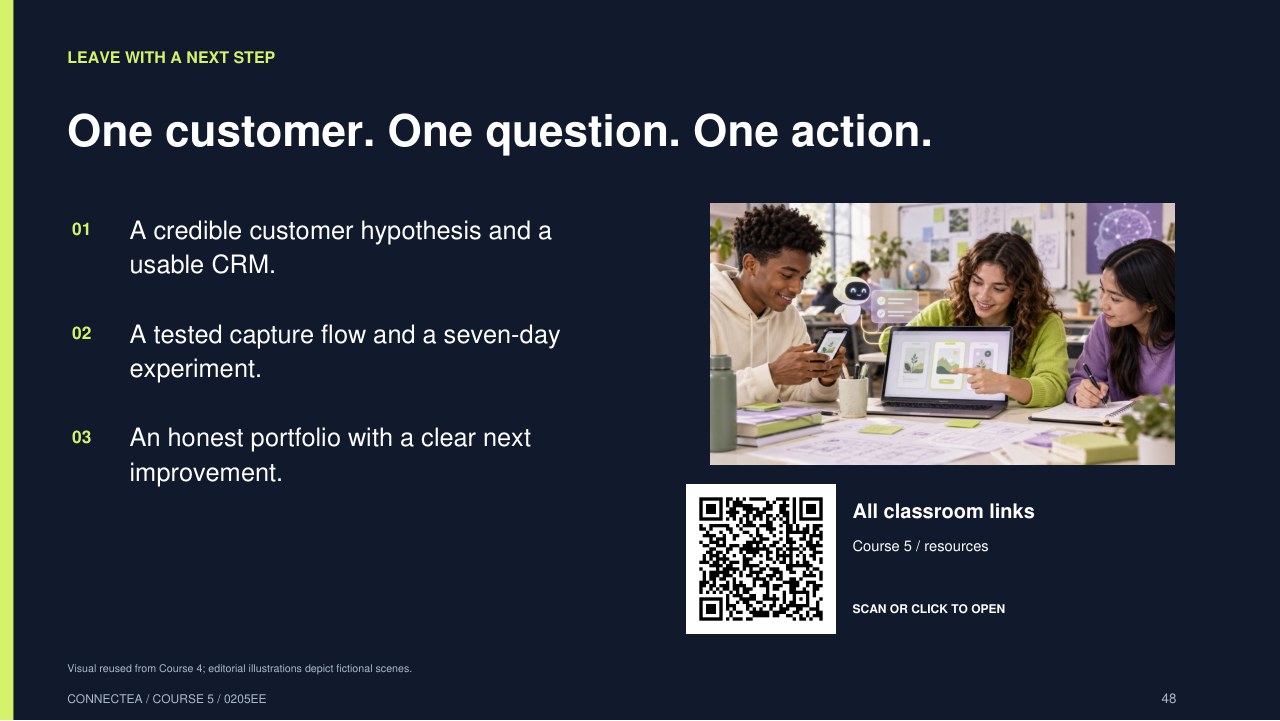
One customer. One question. One action.
- A credible customer hypothesis and a usable CRM.
- A tested capture flow and a seven-day experiment.
- An honest portfolio with a clear next improvement.
Teaching notes
Exit ticket: each student states the next action, who owns it, and when it will happen. Collect unresolved assignment questions for the instructor. Remind students to save their portfolio evidence in the existing hub.